
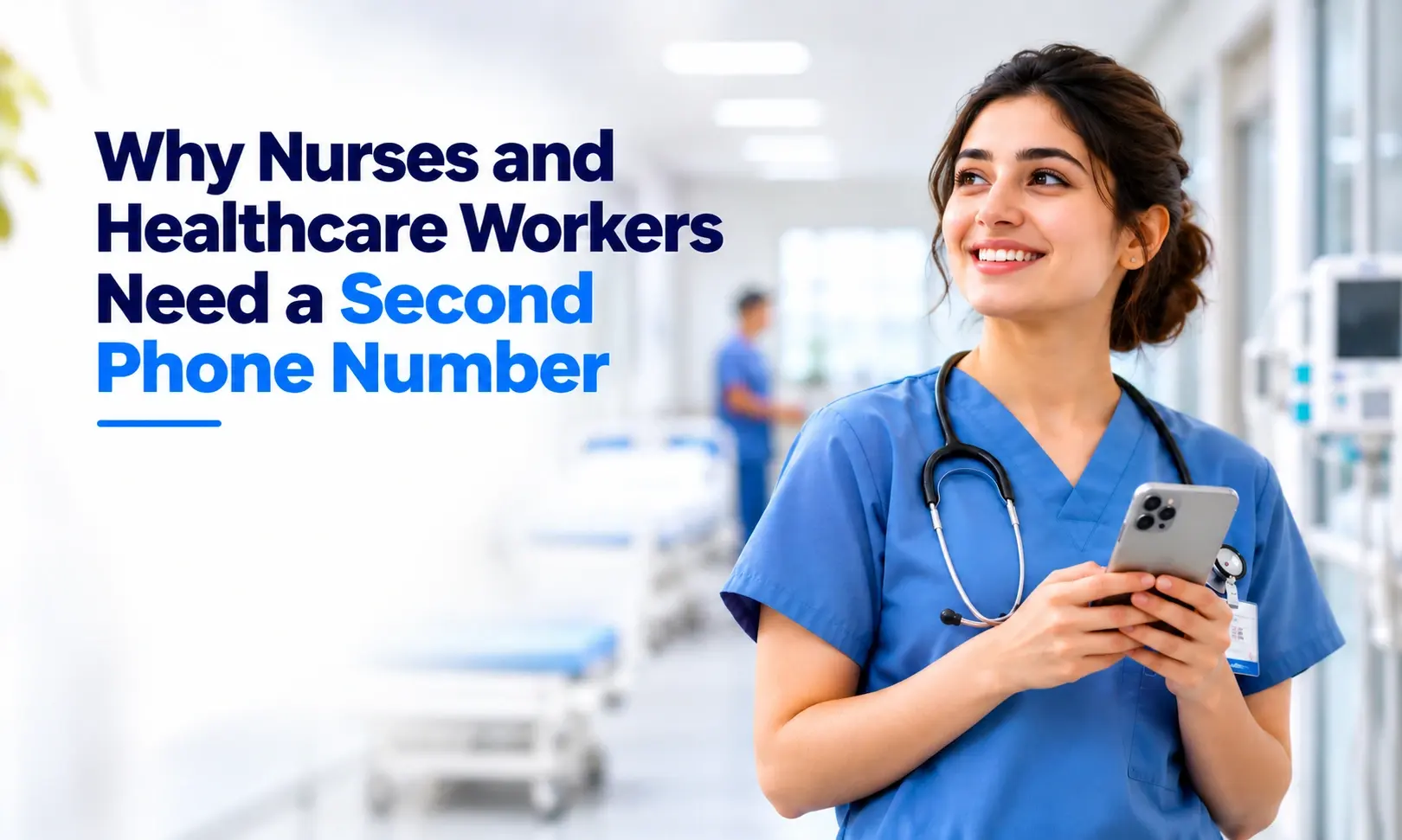
Healthcare is one of the very few professions where patients will directly ask you for your personal phone number, and where the social pressure to give it feels almost impossible to resist.
You are in a position of trust. The person asking is often frightened or vulnerable. Saying no can feel like abandoning someone who needs help. So a lot of healthcare workers give their number, even when they know they probably should not, because in the moment it feels like the right thing to do.
What happens next is the part nobody talks about enough.
The Problem With Patients Having Your Personal Number
The Royal College of Nursing published a policy statement specifically on nursing staff using personal mobile phones for work purposes. The core concern is exactly what you might expect: when a nurse uses a personal device to communicate with patients, the personal phone number is no longer personal.
But the consequences go further than an awkward call outside of work hours.
A patient who has your number does not automatically understand the limits of that contact. They may not know, or may find it difficult to accept, that your shift ended six hours ago and you are not currently their nurse. They may call at 2am about something that feels urgent to them but is a question for whoever is on duty right now. They may call repeatedly. In some cases involving patients with mental health difficulties or conditions affecting their understanding of social boundaries, the contact can become something much harder to manage.
And unlike a work phone provided by a hospital trust, your personal number is also tied to your WhatsApp, your social media recovery, your bank, and everything else in your life. A patient who has it has more access to your world than you probably realised when you gave it.
This is not about being unsympathetic to patients. It is about understanding what that piece of information actually connects to, and whether giving it out is as simple as it feels in the moment.
What the RCN Policy Actually Says
The RCN position statement on personal mobile phones for work purposes makes the boundary explicit. Using personal devices for patient communication raises questions about patient confidentiality, data governance under UK GDPR, clinical record keeping, and blurring of professional and personal boundaries.
Critically, it is not just about what could go wrong with the patient. It is about what happens to patient data when it is handled through personal devices and personal numbers that are not under the governance of the NHS or the employing trust.
If a clinical conversation happens over a personal text message, that conversation is not in the patient's clinical record. It is not accessible to the MDT. It cannot be audited. If something goes wrong, the content of that communication is sitting in your personal inbox, not in a system anyone can review.
Most hospital trusts have their own guidance prohibiting or restricting the use of personal numbers for patient contact. The practical reality is that these policies are often inconsistently followed, particularly in community nursing, district nursing, mental health teams, and other settings where staff work more independently and where the expectation of being reachable is higher.
When Being Contactable Is Part of the Job
There are legitimate reasons why healthcare workers need to be reachable outside of a fixed location.
District nurses coordinating care across multiple homes. Community mental health workers who are the primary point of contact for people they are supporting. Midwives who need to be reachable by women in their care for out of hours questions. GP practice nurses who receive queries between appointments. Healthcare assistants managing rota changes and shift cover through a team group chat.
In all of these situations, being contactable is a genuine operational requirement, not an optional extra. The question is not whether to be reachable, it is what number to be reachable on.
A second phone number separates those two things cleanly. You are contactable. Whoever needs to reach you for work purposes can reach you on a number that works exactly like a mobile number for calls and texts. The difference is that it is not your personal line, not connected to the rest of your life, and not something you cannot manage if the contact becomes problematic.
The Specific Situations Healthcare Workers Deal With
Patient contact outside of working hours. The most common scenario. A patient has your number and calls you when you are off shift, on leave, or dealing with something else entirely. If the number they have is your second line, you can manage that call differently from how you would manage a call from your mother on your personal phone. You can triage it, let it ring, return it when appropriate, or refer it to the on call team without it being mixed in with your real life contacts.
Shift coordination and rota management. Healthcare teams often use group chats and direct messages for operational coordination. Bank staff, agency workers, and people covering shifts often end up with a large number of colleagues' numbers. A second number for work coordination keeps that contact separate from personal WhatsApp, particularly for bank or agency staff who move between different trusts and settings.
Mental health and learning disability settings. The clinical and ethical complexity of patient contact in these settings is higher than in most others. Patients may have limited understanding of professional boundaries, may interpret personal contact details as indicating a personal relationship, or may contact repeatedly in ways that the patient finds reasonable but the staff member finds distressing. Having a clinical contact number that is clearly a professional line, and that can be managed at a professional level, helps maintain those boundaries more clearly than a personal mobile that blurs them.
District and community nursing. Working alone in patients' homes creates a contact dynamic that ward based nursing does not have. Patients may feel that the nurse visiting them has a more personal relationship with them than is the case. Giving a second work number rather than a personal one is a boundary that community nurses can enforce without feeling as though they are being cold or unhelpful.
How to Set This Up Practically
The setup takes about five minutes and costs a fraction of what most healthcare workers spend on a coffee during a shift.
Download a second number app and get a separate number. You can see exactly what Second Line Number provides on our features page. Give this number as your work contact. Patients, colleagues for rota purposes, and anyone else who needs a number for work related contact gets this number.
Your personal number stays for the people in your actual life: family, friends, anything unrelated to work.
If a call comes through on the work number at a time you are not working, you can let it go to voicemail or deal with it without it landing in the same mental space as a personal call. If you change role, move to a different team, or simply want to stop using that number, you can without it having any effect on your personal phone or the contacts who matter to you personally.
If you want to understand the full picture of what a second number does and does not give you in terms of privacy, our blog on what a second phone number actually provides versus full anonymity is worth reading before you decide.
Get a second number for work and keep your personal line exactly that
What About NHS Provided Devices?
Some NHS trusts provide staff with work phones. If yours does, use it. That is the straightforward answer.
The problem is that trust issued devices are not universal. Band 5 nurses on acute wards are often expected to use personal phones for communication because the trust does not have the budget or the systems to provide alternatives. Community teams are sometimes told that a work phone is available but in practice share one device between several staff members.
In these situations, a second number app on a personal device is a practical middle ground. It does not solve the data governance question entirely, because the device is still personal, but it does create a clear separation between personal contact and work contact at the number level, and it gives the individual healthcare worker a layer of protection that not having a second number does not provide.
Our guide on why using one phone number for everything creates risk explains the broader principle if you want to understand the full picture.
Download the app and get a dedicated work number today
Set up a second number and stop giving patients your personal one
Frequently asked questions
Is it against NHS policy to give patients my personal number?
Most NHS trusts have guidance that discourages or prohibits using personal devices and personal numbers for patient contact, citing data governance, patient confidentiality under UK GDPR, and clinical record keeping requirements. The practical application of this policy varies significantly across different settings and teams, but the policy direction is consistent: personal numbers are not appropriate for patient contact where trust systems are available.
What if a patient in crisis contacts me on my personal number outside of work hours?
If a patient contacts you in what appears to be a mental health crisis or urgent clinical situation, the immediate priority is their safety. Direct them to the appropriate crisis service, 999 if they are in immediate danger, or the crisis line for your area. Document the contact as soon as you are able and inform your line manager or supervisor. This is a situation where your clinical and professional obligations have to be handled carefully, and your employer should have protocols for exactly this.
Can I give a second number to patients without it being confusing about whether I am their nurse?
Yes. A second number for work purposes is just a contact number. You do not need to explain to a patient that it is a second line rather than your main phone. They call it, you answer. The distinction is relevant to you in terms of managing contact, not to them in terms of whether they can reach you.
What happens if I change trust or role and no longer want patients to be able to contact me?
With your personal number, there is no clean answer. With a second number, you simply stop using it for that purpose or stop actively receiving calls on it. Patients who try the number will either reach a voicemail explaining it is no longer being monitored, or simply not get through. Your personal number is unaffected.
Do other healthcare workers actually use second numbers?
Yes, increasingly. The pattern is particularly common among community nurses, mental health workers, and midwives, who have the highest exposure to out of hours patient contact expectations. It is also becoming more common among GP receptionists and practice staff who manage a high volume of patient queries and find that work contact bleeding into personal contact creates significant stress over time.
- nurses
- healthcare workers
- nhs
- work phone number