Why Charity Volunteers Should Never Give Out Their Personal Number

- Published
- 6 min read
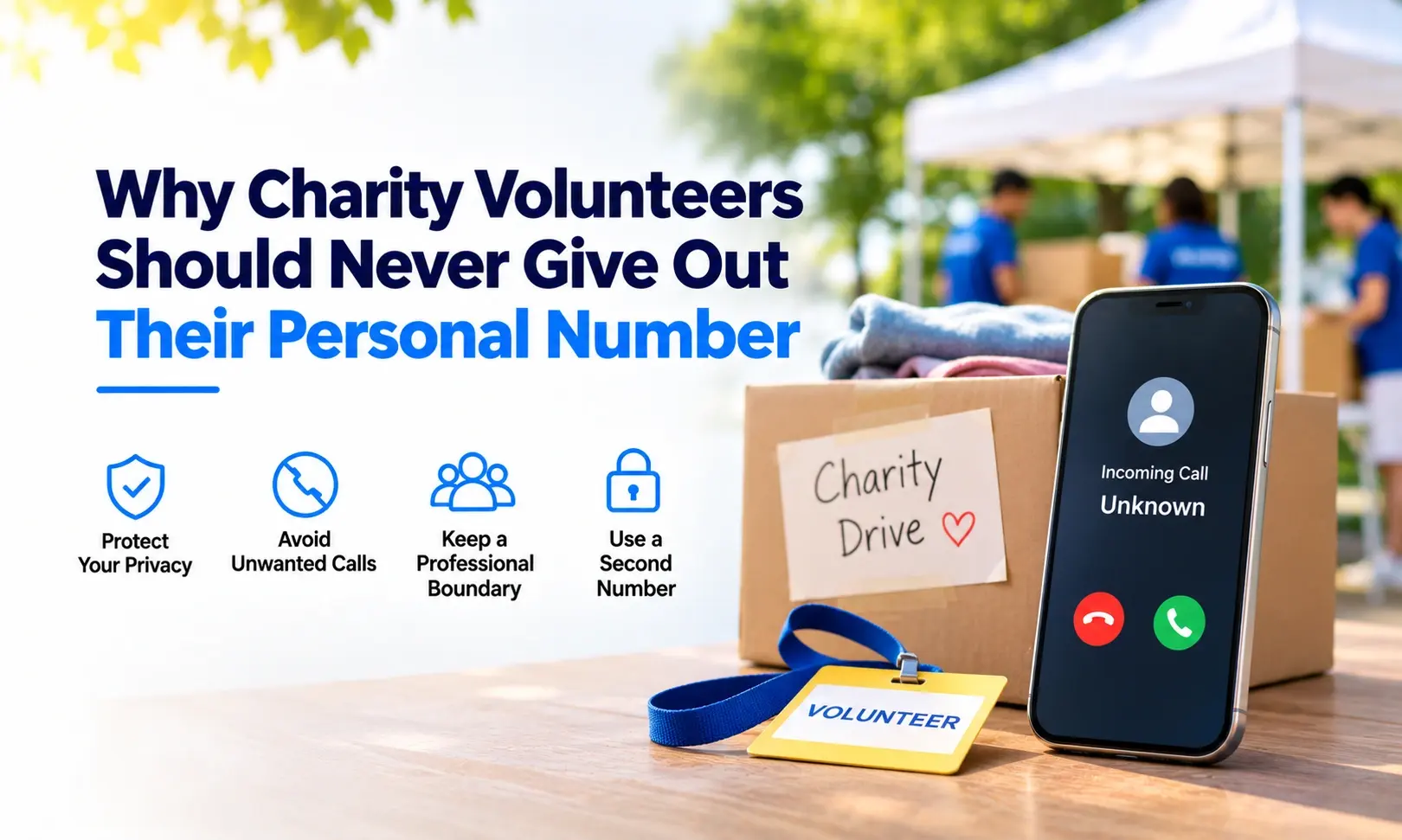
Nobody expects problems when they sign up to volunteer. You are doing something good. The people you are working with are, broadly, trying to help someone. It feels like a context where the usual cautions around sharing contact details do not really apply.
That instinct is understandable. It is also the exact reason this problem comes up so often.
Whether you are coordinating a community event, doing door to door fundraising, running a local support group, or managing a small team of volunteers, the moment someone asks for a contact number is the moment a decision gets made that is much harder to undo than it looks.
This post is about why that decision matters and what to do about it before you end up in the position most people only think about after the fact.
What Actually Happens When Volunteers Give Out Personal Numbers
The short version is that the context changes but the number does not.
When you finish volunteering for an organisation, the people who have your number do not automatically lose access to it. A member of the public you helped during a street fundraising shift. A fellow volunteer who turned out to be difficult. A vulnerable person you were supporting who has become dependent on your direct line. An event attendee who contacts you weeks later about something unrelated.
None of these people were problems at the time. They became problems later. And your personal number, tied to your real identity and the rest of your digital life, is the thread that connects them to you.
This is not a theoretical concern. The Fundraising Regulator in the UK has specific guidance around donor and public contact management for exactly this reason. Face to face and door to door fundraising campaigns involve direct public interaction in a way that creates contact boundary issues that most workplaces never have to deal with.
Charities and volunteer organisations typically manage this risk at the organisational level: providing dedicated contact numbers, briefing volunteers on not sharing personal details, and using coordination platforms that keep personal numbers out of the picture. But not every organisation has these systems in place. And in informal volunteer contexts, like a neighbourhood community group or a community WhatsApp channel you are running, there is often no one thinking about this at all.
The Specific Situations Where This Goes Wrong
Understanding exactly where the problem appears makes it easier to see why a general answer, just be careful, does not really solve anything.
Door to door fundraising and campaigning. Whether for a charity, a political party, or a community cause, door to door work involves giving your contact details to strangers at their front doors. The request often comes from the householder who wants to follow up with a question or complaint, or from a coordinator who needs everyone reachable. In both cases, your personal number travels further than the conversation it started in.
Running a local group or network. Community Facebook groups, neighbourhood WhatsApp channels, local mutual aid networks. These are built on the assumption that everyone is trustworthy because the geography is shared. That assumption is often, but not always, correct. A number you put into a group of 200 local contacts has effectively been shared with 200 people whose full intentions and stability you cannot verify.
Coordinating other volunteers. Managing a team of volunteers often means being the contact point for everyone: the person who gets called when there is a problem, when someone needs to drop out last minute, or when the event setup is running late. This is a legitimate coordination need and it requires being reachable. But it does not require your personal number to be the thing that is reachable.
Supporting vulnerable people directly. If your volunteering involves working with people who are in difficult situations, mental health crises, homelessness, domestic abuse, or similar, the boundaries around personal contact become important for different reasons. Healthy contact limits protect both the person being supported and the volunteer doing the supporting. Giving a personal number can blur those limits in ways that are hard to walk back.
What a Separate Number for Volunteering Actually Does
A second phone number gives you a working, receivable number that you can use as your contact for everything related to your volunteer work, while your real number stays separate.
The practical effect is simple. Anyone who contacts you through that number can reach you for calls and texts. From their side it works exactly like any mobile number. From your side, you can see which calls and messages are coming through the volunteer line versus your real contacts, and you can manage each separately.
If a situation develops where someone is using that contact in a way you are not comfortable with, you have options that you do not have with your personal number. You can quiet that line, stop it receiving calls from specific contacts, or simply step back from it without the action affecting your actual phone or the people in your real life.
That flexibility matters more than it sounds in volunteer contexts, because the situations that create contact boundary problems are often ones that build slowly. What starts as a reasonable follow up message becomes something else over several weeks. Having the volunteer line as a separate layer means you can respond to that shift without it affecting everything else.
You can see how Second Line Number is set up for exactly this kind of use case on our features page.
Set up a number for your volunteer work. Keep your personal line personal.
For the Organisations Running the Volunteers
If you coordinate other volunteers rather than just being one, this section is for you.
The single most common source of contact related problems in volunteer organisations is the assumption that volunteers will sort out their own contact arrangements. They will give their number when asked, someone will call them at midnight about something that could have waited, and if the relationship with that person becomes difficult, the volunteer has no clean way to manage it.
A straightforward approach for organisations is to be explicit about this before it becomes an issue. Provide volunteers with guidance on not sharing personal numbers as a default. If the organisation can provide dedicated numbers for key coordinator roles, that is worth doing. If the budget does not stretch to that, pointing coordinators toward second number apps is a practical alternative that costs very little and removes a real operational headache.
The Fundraising Regulator guidance on face to face and door to door work is worth reading if your organisation does this kind of public interaction regularly. Contact management during campaigns is treated as an organisation level responsibility, not something individual volunteers should be improvising.
When You Are the One Who Has Already Shared Your Number
If you have already given your personal number in a volunteering context and the contact is now becoming something you want to manage differently, the same principles apply as in any unwanted contact situation.
You cannot take back a number that has already been shared. But you can change your approach going forward, give a second number to any new contacts or contexts, and separately manage the existing contacts on your personal line in whatever way makes sense for each.
For anyone whose volunteer contact has become genuinely distressing or unsafe, the same escalation routes apply as in any other harassment situation. Our guide on how to protect your phone number without changing it covers the general framework. The context being volunteer work rather than something else does not change the practical steps.
Get a second number for your volunteer work and keep your personal line yours
Frequently asked questions
Is it a GDPR issue if volunteers use personal numbers for charity work?
It can be, depending on the context. Under UK GDPR, if a volunteer is processing personal data of members of the public or beneficiaries through a personal device and personal number, there are questions about where that data is held and how it is secured. Charities have a responsibility to think about this at an organisational level. Using a dedicated number for volunteer activity, separate from a personal line, helps create a cleaner boundary between personal and volunteer data handling.
My volunteering is very informal, just a local WhatsApp group. Does this still matter?
It depends on the size and nature of the group. A WhatsApp group of a few close neighbours is different from a 200 person community network. The larger and more public facing the group, the more the usual cautions apply. The question to ask is whether you would be comfortable with everyone in that group having unrestricted long term access to a number tied to your real identity.
What if the charity I volunteer for requires a phone number for coordination?
Give them a second number instead of your personal one. From their perspective, it is a working number they can reach you on. From your perspective, it is a contact point for that specific context that does not expose your real number to however many people will end up with it before the end of the campaign.
Can I use a second number on WhatsApp for volunteer group chats?
Yes. A second number that passes WhatsApp verification can be used to create a WhatsApp account specifically for volunteer activity, keeping that contact entirely separate from your personal WhatsApp. This also means that if you want to step back from that contact, you can do so without it affecting your personal WhatsApp and the contacts there.
What do I do if a vulnerable person I was supporting keeps contacting me on my personal number?
This is a real situation that comes up in direct support volunteering. The first step is to speak with your organisation's coordinator or lead, if there is one. Many volunteer organisations have specific guidance for exactly this because it is not uncommon. If there is no organisation structure, the practical approach is to make any further contact through a dedicated line and gently redirect contact to that channel going forward. Trying to manage it on a personal number without any structure around it typically makes the situation harder to resolve, not easier.