You have one phone. It is the phone your mum calls, the phone your employer texts, the phone your doctor leaves voicemails on, and the phone your work colleagues message at 9pm about something that could have waited until morning.
All of it comes into the same place. All of it rings the same ring. None of it has any separation.
This is how most people live, and most people have quietly accepted it as the only way things can be. You have one number. You gave it to work. Now work has it forever, and the boundary that used to exist between your job and your personal time is significantly thinner than it was.
You do not need a second phone to fix this. You need a second number.
Why Mixing Work and Personal on One Number Creates Problems Beyond Just Noise
The obvious problem is the obvious one: work calls bleed into personal time. A client calls on a Sunday. A manager texts at midnight. A recruiter contacts you three months after you left a job because your number is still in the company CRM.
But there is a less obvious problem that matters more.
When you give your employer or your clients your personal number, you are giving a professional context permanent access to a number that was not designed for that context. Your personal number is linked to your personal accounts, your family’s contacts, your banking, and your identity. It was set up for personal use and it has accumulated years of personal connections.
Mixing work contact into that number is not just inconvenient. It means that when a work relationship ends badly, when a manager turns out to be someone who does not respect boundaries, or when you leave a job and do not want ongoing contact from that organisation, the number they have is the number everyone important to you also has. There is no clean separation because there never was one.
Our blog on why using one phone number for everything creates long term risk covers the broader version of this problem. The work context is one of the most common places it becomes concrete.
The Options People Try and Where They Fall Short
Dual SIM phones are the most common hardware solution. You put a personal SIM in one slot and a work SIM in the other. Calls and texts come in on the right number. The problem is that not every phone supports dual SIM, not everyone wants to manage two active contracts with two monthly bills, and the physical SIM approach is inflexible if your circumstances change.
Carrying two phones is the obvious extreme version. Many people do this, particularly in sales and real estate roles where a dedicated work device is normal. It is effective but it creates a different problem: you are now managing two devices, two batteries to charge, two screens to check, and two sets of notifications. For most people this is more overhead than the problem it solves.
Relying on work devices works when your employer provides one. It does not help freelancers, contractors, side hustlers, or anyone who is self employed. It also does not help people in employed roles where a work phone is not provided but work contact still happens on personal numbers constantly.
Carrier plans with multiple lines exist but typically add meaningful cost to a monthly bill for a permanent solution to what may be a temporary or seasonal need.
The Cleaner Solution: A Second Number on the Same Device
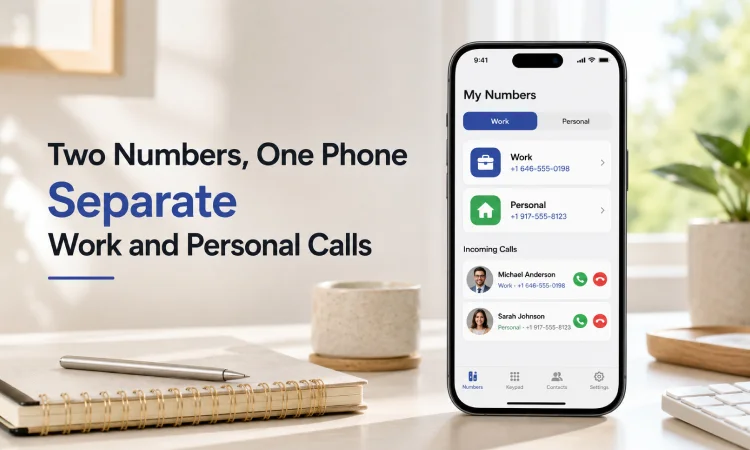
A second phone number app gives you a fully functional second number on your existing phone. Calls and texts to that number come through to the same device you already carry. You can see at a glance which number is being called and handle it accordingly.
This is not a workaround or a technical trick. It is a real phone number that works across calls, texts, and voicemail. The difference from your primary number is that it is assigned to a specific context, which means it comes with a clean boundary built in.
Give the work number to clients, colleagues, and professional contacts. Keep your personal number for family, friends, and anyone else you want to reach you on a genuinely personal line. When work calls come in on the work number, you know before you answer what context you are stepping into. When the work day ends and you want to stop thinking about work, you stop checking the work number.
This is not about hiding from responsibilities. It is about having a clear, functioning boundary between two parts of your life that are both legitimate but are better kept separate.
You can see exactly how Second Line Number is set up for this kind of professional use on our features page.
→ Get your work number set up on your personal phone today
The Specific Situations Where This Matters Most
Freelancers and contractors who work with multiple clients simultaneously often have client contact happening across multiple projects at once. A second number dedicated to client work keeps all professional contact in one place, separate from personal, and creates a clear on and off switch at the end of a project or contract.
People in sales, letting, or client facing roles who are expected to be reachable by clients but want some control over when and how. A work number that goes to voicemail after hours, with a professional message, is significantly better than a personal number that rings indefinitely and makes every unanswered call feel like a missed obligation.
Side hustlers who run something alongside a full time job, whether tutoring, a resale business, food delivery coordination, or any other second income, need to keep the two contexts completely separate for both professional reasons and sanity reasons. Customers of a side hustle do not need to be in the same contact ecosystem as a primary employer.
Remote workers whose personal and professional lives share a physical space, a home office or a kitchen table, often find that a separate work number helps maintain the psychological boundary between work time and personal time even when the physical boundary is gone. A number that rings only during work hours is a surprisingly effective tool for remote work discipline.
People considering leaving a job who do not want a prospective employer to see the same number as their current employer, and who do not want their current employer to have their number after they leave.
What Happens When You Give Work Your Real Number and Then Leave
This is a specific scenario worth naming clearly.
You join a company. You give HR your personal number. It goes into the payroll system, the staff directory, the fire evacuation list, the client management system, the internal messaging platform, and your manager’s personal phone. Over a year or more of employment, your number accumulates connections across the organisation.
You leave. You take your personal number with you. But all those copies of it stay behind. The HR system keeps it on file. Your number remains in the client CRM unless someone manually removes it. Former colleagues keep texting you about things that are no longer your concern. A client who liked working with you specifically keeps calling your personal line because they do not know who has replaced you.
You cannot recall a number once you have given it. You can only manage the consequences. A work number used specifically during your time at that employer can be retired when you move on. The consequences are contained to a number that was used for work, not to the number that has been your personal contact for years.
Our blog on why your employer should not have your personal phone number covers the same theme from the employee protection angle.
Frequently Asked Questions
Can I have two phone numbers on one phone without a second SIM card?
Yes. A second number app gives you a fully functional phone number on your existing device without needing a second SIM, a second contract, or a second phone. Calls and texts to the second number come through the same device. You can see which number is being called before you answer.
Is a second number good enough to use as a dedicated work number?
Yes. A second number functions identically to a standard mobile number for calls, texts, and voicemail. Clients, colleagues, and professional contacts call it and reach you normally. The difference is that it is on a separate line from your personal number, so professional contact stays in a distinct context from personal contact.
What happens to my work number if I leave a job or end a contract?
If you have used a dedicated second number for a work role, you can simply stop using that number when the role ends. Former colleagues and clients who have that number can no longer reach your personal line directly. You retain your personal number with no disruption, and no connection between the professional role and your personal contact details persists.
How do I know which number is being called when both come to the same phone?
Second number apps show clearly which number is receiving an incoming call or message before you engage with it. Most display the number name or label, such as “Work” alongside the caller’s identity. This gives you the context to decide how to answer, or whether to answer, before picking up.
Does having a second number mean I need to check two separate inboxes?
No. Both numbers come into the same device and the same app. You manage them in one place. The separation is about which number other people have, not about juggling two separate phones or accounts.
→ Download Second Line Number and set up your work line on your personal phone in minutes