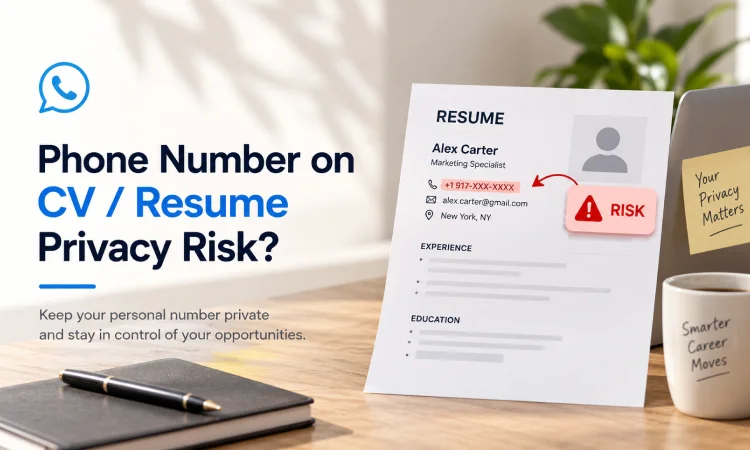
Almost every CV has a phone number at the top. It has been standard for decades. You put it there so employers can call you. That part makes sense.
The part that does not get talked about is what else happens to that number once the CV leaves your hands.
Because a CV is not a document that goes to one place and stays there. When you apply for a job online, your CV enters a system. That system is often shared, resold, accessed by multiple people, and in some cases sits in databases indefinitely. The phone number at the top of your CV travels with it through all of that.
Where Your CV Actually Ends Up
Job portals are not neutral filing systems. They are platforms with commercial incentives, data agreements with third parties, and varying privacy policies that most applicants do not read before uploading.
When you upload your CV to a job board, your contact details, including your phone number, typically become part of that platform’s candidate database. Some platforms keep that data for years after you last logged in. Some share it with partner companies. Some sell aggregated candidate data to marketing firms, background check services, or employers you never applied to.
A recent article on job seeker privacy described ghost jobs, postings that are never intended to be filled, as a specific data collection risk. Candidates hand over a complete personal profile, including phone number, work history, and salary expectations, in response to a job that does not exist, and that data enters corporate databases with no real oversight.
Even for legitimate job postings, recruitment data is one of the most commonly mishandled categories of personal information in most organisations, because it comes from people who are not yet employees and have not established a formal relationship with the company. It often sits in spreadsheets, individual email inboxes, and applicant tracking systems with varying access controls.
What Happens When a Recruiter Has Your Number
Most recruiter contact is entirely appropriate. A call to discuss a role, a text to confirm an interview time, and a voicemail when you did not pick up. This is normal and expected.
The problem is what happens beyond that initial contact and with the recruiters and agencies further down the pipeline who also end up with your number.
When you apply through a recruitment agency, your CV typically gets added to their candidate database. Agencies share candidate databases across offices and sometimes across partner agencies. A number submitted to one agency in London can end up being called from an office in a completely different city months later by someone who has never spoken to you.
According to a job seeker privacy resource, fraudsters specifically harvest CVs from job portals to build call lists. The calls claiming to offer jobs that require upfront payments for background checks, training kits, or onboarding fees – those people got your number from your CV or from a database it ended up in.
There is also the basic annoyance category. Recruiters calling about roles you have no interest in, at times that are inconvenient, from numbers you cannot easily identify. Anyone who has ever done an active job search knows this experience well. It rarely stops after the search ends.
The Recruiter Database Problem That Outlasts Your Search
Here is the specific dynamic that catches most people off guard. When you find a job and stop actively searching, you stop thinking about the CVs and applications you submitted. The recruiters do not.
Your number remains in their systems. It continues to be used to contact you about future roles. If the agency changes hands or merges with another, your data typically transfers with the business. There are legal frameworks covering this in the UK and EU under GDPR, but enforcement is inconsistent and many candidates never exercise their right to request deletion.
A CV with your personal number is a document that circulates through systems you cannot see or control, carrying a piece of contact information that has a very long shelf life.
What the Solution Actually Looks Like
The advice from job seeker privacy guides and recruitment professionals is consistent on this point: use a separate number for your job search. One that you can silence when you are not actively looking. One that stops receiving calls the moment you have accepted a role and no longer need it. One that keeps your personal number, the one your family and existing employer call, entirely separate from the process.
This is not a complicated setup. A second phone number used only for your CV and job applications means every recruiter, every database, every platform that handles your application, gets a number that is connected to your job search only, not to your whole life.
When the search ends, that number goes quiet. The calls that continue coming after you have accepted an offer go there instead of to your real number. The data that circulates in recruitment systems long after you stopped looking points nowhere important.
Several CV formatting guides now specifically recommend using a virtual or secondary number rather than a personal number on any publicly uploaded resume. The same number you would give a vetted employer in a private application is not the number that should sit on a profile that anyone with an account on a job board can see.
You can see exactly how Second Line Number works for this kind of use case on our features page.
→ Get a second number for your CV and keep recruiter calls separate from your real life
A Practical Checklist Before Your Next Application
Go through these before you upload a CV to any new platform.
Check whether your current CV has your personal number on it. If yes, consider replacing it with a dedicated job search number before uploading.
Check the privacy policy of any platform before you upload. Look specifically for how long they retain candidate data and whether they share it with third parties.
If your CV is already sitting on platforms from a previous job search, log in and either delete the profile or update the phone number to something you are comfortable having in circulation indefinitely.
If you are using a second number for your search, set it up with a professional voicemail that includes your name, so recruiters who call get a clear, credible response rather than a generic message.
If you have questions about setting up a second number for your job search, our support centre has answers or you can contact us directly.
Frequently Asked Questions
Should I put my phone number on my CV?
A phone number on your CV makes it easier for employers to contact you and most recruiters still expect to see one. The question is which number. Putting your personal primary number on a publicly uploaded CV exposes it to recruiter databases, job platforms, and potential data sharing arrangements that continue long after your job search ends. A dedicated second number used only for job searching gives recruiters the contact they need without your personal number circulating in systems you cannot control.
Do recruiters keep your phone number after you find a job?
Yes. Recruitment agencies typically retain candidate data in their databases long after a placement is made, since the same candidates may be suitable for future roles. Your number stays in their system unless you actively request deletion under applicable data protection laws. In the UK and EU, GDPR gives you the right to request that your data be removed. This right exists but is rarely exercised by candidates who simply moved on after finding work.
Is it safe to put my phone number on a publicly visible job board profile?
It carries meaningful risk. Phone numbers on publicly visible profiles can be harvested by data brokers, accessed by fraudulent recruitment operations looking to build call lists, and collected by anyone with access to the platform. Most career advisors and privacy guides now recommend keeping your personal number off public profiles and supplying it only through controlled applications to verified employers.
What is the risk of my CV being uploaded without my knowledge?
This happens more often than most candidates realise. Recruitment agencies sometimes upload candidate CVs to additional platforms or partner agencies to maximise exposure without explicit consent. Under GDPR this requires a lawful basis and appropriate notification, but enforcement varies. Using a dedicated job search number rather than your personal number limits the damage if your CV ends up somewhere you did not intend.
Can I use a virtual number on my CV?
Yes. A virtual or second number that functions normally for calls and texts works perfectly as a CV contact number. Recruiters who call it reach you normally. The difference is that it is a number tied specifically to your job search rather than to your permanent personal identity. You can manage or stop using it once the search is over without it affecting your real number or the people who have it.
→ Start your free trial with Second Line Number and take your personal number off your CV