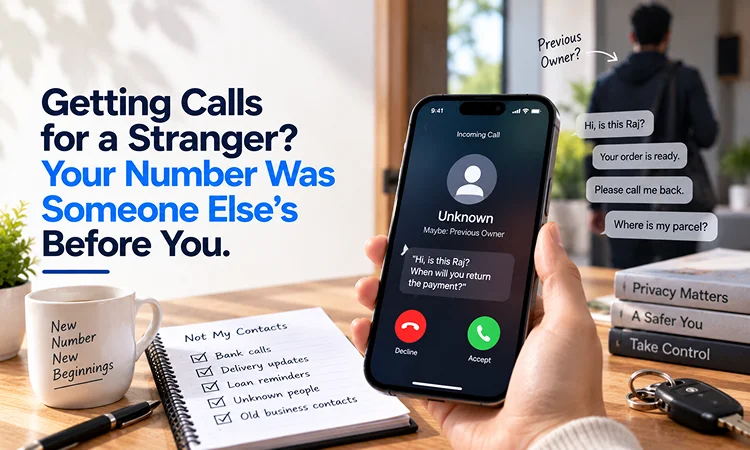
You got a new number. Or maybe you have had yours for years. Either way, someone calls and asks for a name that is not yours. A text arrives from a pharmacy about a prescription. A bank sends a verification code that was not requested. A friend of someone you have never met messages to check in.
If this is happening to you, the explanation is straightforward: phone numbers get recycled. The number you are using now may have belonged to someone else before you, and the digital connections to that previous owner have not fully unwound yet.
For most people this is a minor inconvenience. For some it creates real problems, and understanding exactly how it works reveals something important about your own number too, and what happens to it when you eventually stop using it.
Why Phone Numbers Get Recycled
There are roughly ten billion possible phone numbers in the standard US numbering format. That sounds like a lot until you consider how many numbers have been assigned, then abandoned, across the decades of mobile phone use. The Federal Communications Commission estimates that approximately 35 million phone numbers are recycled in the US every year.
When someone stops paying their bill, changes carrier, upgrades to a different number, or simply stops using a phone, the carrier eventually reclaims the number. After a quarantine period, which is meant to allow time for the previous owner’s accounts to detach, the number gets reassigned to a new customer.
The quarantine period helps. It does not solve the problem. Platforms, apps, services, and individuals who saved that number do not necessarily know it has been reassigned. The digital footprint of the previous owner often stays attached long after the number has changed hands.
What This Looks Like in Practice
A Princeton University study obtained 200 recycled numbers and monitored them for one week. Of those 200, 19 were still receiving security and privacy sensitive calls and messages, including authentication passcodes and prescription refill reminders, clearly intended for the previous owner.
The same study found that 171 out of 259 sampled recycled numbers returned results on people search services, meaning a new owner could look up the previous owner’s name, address, education, work history, and social media profiles simply by entering the number they had just acquired.
And in a finding that is genuinely alarming: 171 of those 259 numbers were linked to active accounts on Amazon, Facebook, Google, PayPal, AOL, and Yahoo, meaning someone acquiring the recycled number could trigger a password reset, receive the OTP to that recycled number, and complete the login on an account that still belonged to the previous owner.
That is not a hypothetical attack scenario. It is the documented output of a controlled research study. A recycled number, acquired entirely legitimately through a carrier, can under these circumstances become a key to someone else’s accounts.
The Risk Goes Both Ways
Most people reading this are on the receiving end, dealing with the inconvenience of calls and texts for a stranger. But the more important implication runs the other direction.
When you eventually stop using your current number, whether by changing carriers, upgrading, switching to a different number, or simply letting a pay as you go SIM lapse, your number goes back into the pool. And the same risks apply to you.
Every account you have ever linked to your current number is potentially accessible to whoever gets it next, if they choose to exploit that access. Every platform that uses your number for two factor authentication. Every app where your phone is used for password recovery. Every service you signed up for with your number and never updated.
This is not a remote or abstract risk. Research from ID Dataweb estimates that the Consumer Financial Protection Bureau observed a 35 percent increase in credit fraud cases tied to recycled numbers. The FBI’s Internet Crime Complaint Center recorded a 400 percent increase in SIM swap attacks from 2020 to 2024, many of which involve recycled SIM cards.
The habit that reduces this risk significantly is limiting how many accounts are tied to your real personal number. A second number used for signups, verifications, and low trust contexts means fewer accounts tied to the number you will eventually release. When that number gets recycled, the blast radius of connected accounts is much smaller.
We cover the full picture of how your phone number persists across platforms and what to do about it in our blog on how long your phone number stays linked to you online. It is worth reading alongside this one.
What to Do If You Are Getting Calls for the Previous Owner
The first thing worth acknowledging is that most of what comes through is genuinely just noise: calls for an old pizza order, a check-in from a school friend, an appointment reminder from a dentist. This settles down naturally over time as the previous owner updates their details or as services clear their records.
A few things speed the process along.
If someone calls asking for the previous owner, tell them clearly and briefly that this number no longer belongs to that person. You do not owe anyone an explanation, but a single clear message usually stops repeat calls from people who just did not know.
If you are receiving two-factor authentication codes or password reset messages for accounts you do not own, do not use them. Do not attempt to access the accounts. The correct response is to ignore these messages entirely. If you want to be helpful, the service itself usually has a way to report that a number has changed hands, though this is not something you are obligated to pursue.
If you are receiving calls or texts that feel more sensitive than a generic appointment reminder, such as medical, financial, or legal communications clearly intended for a named individual, you can try contacting the sender directly to let them know the number has changed. This is genuinely useful to the previous owner even if you will never meet them.
If you are experiencing a high volume of calls that genuinely disrupts your use of the number, it is worth contacting your carrier. In some cases, particularly with numbers that have a heavy call history, carriers can expedite a full number change. This is a nuclear option but it is available.
What You Should Do With Your Current Number Right Now
Here is the part that matters more than dealing with calls from strangers: checking what is tied to your own number before you eventually release it.
Go through your accounts. Banking apps, email, social media, shopping, streaming, anything that has your current number stored for two factor authentication or account recovery. Update those to a number you will keep permanently, or use an authenticator app rather than SMS based two factor where the service allows it.
Unlink your number from accounts you no longer use. A dormant account you forgot about is not a reason to keep your number connected to it, and it is not something the next owner of your number should be able to access.
Think about which signups still have your number and whether they need it. Many people discover during this process that dozens of services have their number saved from years ago with no ongoing reason to keep it. Removing it where possible reduces the footprint.
Using a second number for new signups going forward means this problem does not compound further. Our features page shows how Second Line Number works for exactly this kind of separation between your permanent number and your disposable one.
→ Keep your real number out of accounts you might walk away from one day
A Note on WhatsApp Specifically
WhatsApp deletes account data associated with a number if the account has been inactive for 45 days. This is their stated policy, and it is designed to reduce the risk of the incoming owner of a recycled number accessing previous WhatsApp messages.
In practice, if the previous owner was an active WhatsApp user and recently lost or changed their number, the 45-day window may not have passed when you receive the number. You could receive messages intended for them during that window.
The same principle applies to your own WhatsApp account. If you plan to change your number, update your WhatsApp to the new number before releasing the old one. This transfers your account to the new number cleanly and prevents your conversation history from becoming accessible to whoever gets your old number next.
We cover the WhatsApp persistence risk in more detail in our guide on how your phone number outlives you online.
If you have any questions about how Second Line Number handles number separation and account linking, our support centre has answers, or you can contact us directly.
Frequently Asked Questions
Why do I keep getting calls and texts meant for someone else?
Your phone number was previously owned by someone else and was recycled to you when they stopped using it. The people and services contacting you still have the old number saved and do not know it has changed hands. This is extremely common. The FCC estimates approximately 35 million numbers are recycled in the US each year. The volume of misdirected contacts usually reduces over time as old records are updated.
Is it safe to have a recycled phone number?
Generally yes, though it depends on the number’s history. A Princeton University study found that a significant portion of recycled numbers were still receiving security-sensitive messages like two-factor authentication codes and password reset links meant for the previous owner. A new owner who exploits this could potentially access those accounts. This does not mean you should refuse a recycled number, but it is worth monitoring what arrives in the first few weeks.
Can the person who had my number before me access my accounts?
Not directly, because you now own the number. However, if the previous owner still has their number saved on any devices or accounts, they may receive calls meant for you on forwarded lines or may have set up secondary devices that still recognise the old number. More relevantly, when you eventually release this number, whoever gets it next could potentially access any accounts you leave linked to it. This is the more significant risk to address.
What should I do if I keep receiving two-factor authentication codes for someone else?
Do not use them. Do not attempt to access the accounts they relate to. Ignore the messages. The correct response is to let them expire naturally. If the volume is significant and persistent, you can try contacting the service directly to report that the number has changed hands, which helps both the previous owner and reduces misdirected messages to you.
How do I protect myself when I eventually change my own number?
Before releasing your current number, go through your important accounts and update the associated phone number to your new one. Pay particular attention to banking, email, social media, and any other service using your number for two-factor authentication or password recovery. An account you forget to update becomes a potential access point for whoever receives your old number next.