Craigslist Phone Number Safety: Selling on Craigslist and OfferUp
- Published
- 8 min read
You've photographed the bike, written the ad and set a price. Then comes the field that asks how buyers should reach you. Craigslist phone number safety comes down to that one moment: the number you type there, or later text to a buyer, can travel a lot further than the sale.
Craigslist and OfferUp handle contact details very differently. Craigslist is built around email and a relay that hides your address. OfferUp is built around its own chat, so you never need to share a number at all. Both are targeted by the same family of scams, and most of them start with a "buyer" who wants your phone number or a code that was sent to it.
This guide sticks to those two platforms. If you sell on Facebook, our guide to Facebook Marketplace and your phone number covers Messenger, and our broader piece on protecting your number when you sell online explains why the number matters so much in the first place.
Quick answer
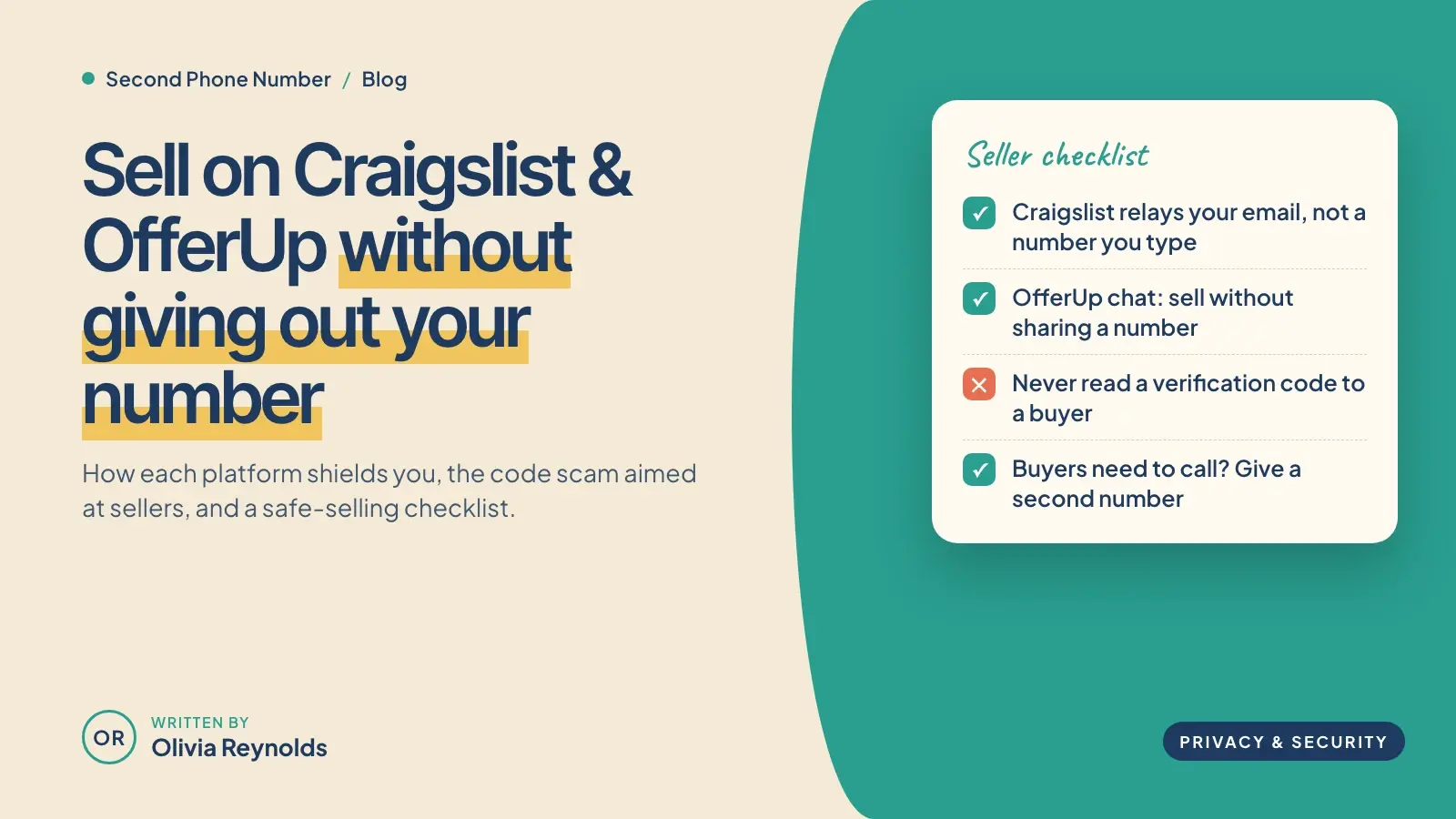
- Craigslist hides your email with a relay, but not a phone number you type into an ad or a reply.
- OfferUp's in-app chat means you can sell without sharing a number at all.
- Never read a verification code to a buyer. The FTC says that's how scammers hijack your number for Google Voice.
- If buyers need to call or text, give them a second number, not your personal one.
What does Craigslist do with your contact details?
Craigslist's main privacy tool is for email, not phone numbers. According to security firm ESET, Craigslist uses a two-way email relay to hide your email address when you talk to buyers or sellers. Messages pass through Craigslist rather than going straight between you, so neither side sees the other's real address.
That protection stops at email. If you put a phone number in the ad, it sits on a public web page that anyone can read and copy. If you send your number in a relay reply, the buyer now has it, along with everyone they pass it to. Our article on why your phone keeps ringing after a car listing explains how numbers in public classifieds get collected and reused for months.
ESET's advice for Craigslist is to use disposable phone numbers and email addresses so your main contact details stay protected, and to report a scam listing with the red flag icon on the post.
Should you list a phone number on Craigslist at all?
For small items, you often don't need one. Email through the relay is enough to agree a price and a time. For bigger sales, such as a car or furniture where buyers want to call, a number does get faster replies. That's the situation where a separate number makes sense: buyers get a working line, and your personal number stays out of the ad.
How does OfferUp keep your number out of the chat?
OfferUp takes the opposite approach. Its in-app messaging lets buyers and sellers talk without sharing personal contact details, and OfferUp recommends keeping all communication on the platform, according to Moonlock's August 2026 OfferUp guide. ESET's advice is the same: don't leave the app for messages or payments.
Two other features matter for sellers:
- TruYou. OfferUp's identity verification option matches a user's government ID to a selfie, and verified users show a TruYou badge on their profile. ESET recommends only buying from or selling to users with the badge. OfferUp first launched TruYou in 2012 "to reduce anonymity in the marketplace", it said in a 2017 announcement.
- Community MeetUp Spots. OfferUp announced the program in November 2017: public, well-lit and surveilled places set up with local police, with more than 450 at launch. ESET's February 2026 guide still tells sellers to meet at one.
A TruYou badge tells you the person passed an identity check. It doesn't tell you the deal is genuine, so keep the rest of this checklist in place.
Craigslist vs OfferUp at a glance
| Craigslist | OfferUp | |
|---|---|---|
| How buyers first contact you | Email through Craigslist's relay, or any number you choose to post | In-app chat |
| Does the buyer see your email? | No, if you use the relay | No |
| Does the buyer see your phone number? | Yes, if you put it in the ad or a reply | Only if you share it |
| Identity check for users | None described in the sources we found | TruYou badge (ID and selfie) |
| Suggested meeting places | Public places (your choice) | Community MeetUp Spots |
| How to report a scam | Red flag icon on the listing | In the chat: three dots, then Report |
This table is based on ESET's and Moonlock's guides and OfferUp's own announcement, checked on 12 November 2026. Craigslist's and OfferUp's help pages couldn't be loaded for this article, so check them in the app before you rely on a detail.
Craigslist phone number safety: the verification code scam
This is the scam to know before you post. The FTC describes it in its consumer alert on the Google Voice scam: someone poses as a buyer on a site like Craigslist or Facebook Marketplace, says they've heard about fake listings and want to check you're a real person, and asks you to read back a code they're about to send to your phone.
The code is a Google Voice verification code. If you share it, the scammer can set up a Google Voice number linked to your phone number, then use it to hide who they are while they scam other people. The FTC adds that if they gather enough of your details, they could try to get into your accounts or open new ones in your name.
OfferUp sellers see a variation. ESET describes "buyers" who ask you to read out a code that will supposedly verify your listing. In fact, they're usually trying to log in to your OfferUp account. Moonlock notes that OfferUp never requires a code to verify a listing or complete a sale.
The FTC's rule covers every version of this: "Anyone who asks you for your account verification code is a scammer," as it put it in a 2024 alert. Google says the same about Voice codes: Google employees will never ask for this code.
What to do if you already shared a code
Don't panic, and act quickly:
- If you don't use Google Voice, go to Google's disconnect page at voice.google.com/regain, which Google points to for people who were tricked into sharing a code.
- If you do use Google Voice, reclaim the number: on a computer, open voice.google.com, go to Settings, choose New linked number under Linked numbers, enter your number, type in the verification code, and click Claim when Voice asks. Google's reclaim instructions walk through each screen.
- If it was an OfferUp or other account code, change that account's password and check its sign-in settings.
- Report it to the platform and to the FTC at ReportFraud.ftc.gov.
Our guide to what to do if you gave your number to a scammer covers the wider clean-up.
What red flags should Craigslist and OfferUp sellers watch for?
Most scams aimed at sellers follow a script. Walk away if a buyer:
- Asks for a code sent to your phone, for any reason.
- Wants to move off the platform right away, to text, a different chat app or email outside the relay.
- Can't meet in person and wants the item shipped, often to someone else.
- Sends a check for more than your price and asks for the difference back. The FTC warns the check is fake, and you lose both the money and the item.
- Pushes a mobile payment you didn't ask for, or a "payment notification" instead of money in your account.
- Has a brand-new profile with no reviews and, on OfferUp, no TruYou badge.
- Won't meet at a public place or a MeetUp Spot, or keeps changing the location.
- Pressures you to hurry or seems vague about the item.
One red flag doesn't prove a scam. Two or three together usually do.
How do you sell safely without giving out your number?
Here's a checklist that works on either platform:
- Keep the first conversation on the platform. Use Craigslist's email relay or OfferUp's chat until you've agreed a price and a time.
- Leave your personal number out of the ad. If buyers need to call, list a second number instead.
- Never share a code. Not to "verify" you, not to "confirm payment", not for anything.
- Sell locally and meet in public. The FTC suggests selling to someone you can meet in person, preferably for cash. On OfferUp, use a Community MeetUp Spot.
- Don't accept overpayments or deposit a check for more than your price.
- Check the buyer's profile on OfferUp for reviews and a TruYou badge.
- Report anything suspicious to the platform and at ReportFraud.ftc.gov.
Where does a second phone number fit in?
Some buyers will want to call or text, especially for big items, and refusing every time can cost you a sale. A second number lets you say yes without handing over the number your bank, email and family use.
Our app, Second Phone Number, gives you a separate US or Canada number on your iPhone with calling, texting and voicemail, next to your existing number. Put it in your Craigslist ad or share it with an OfferUp buyer once you're ready to meet. If a buyer turns into a pest, you can block them on that number without changing your personal one. You can have up to 3 numbers on one account if you'd like one just for selling.
Be clear about what it doesn't do. A second number doesn't make it safe to read out a verification code, because the scam works on whichever number receives it. The rule above still applies. What changes is the damage if a buyer's number ends up in the wrong hands: it's a number you only use for selling, not the key to everything else.
The bottom line
Craigslist protects your email but not a number you post. OfferUp lets you sell without sharing a number at all. On both, the most common trick aimed at sellers is a request for a code, and the answer is always no. Keep conversations on the platform for as long as you can, meet in public, and when a buyer really needs to call, give them a second number rather than your personal one.
Frequently asked questions
Is it safe to put my phone number in a Craigslist ad?
It works, but it's the riskiest option. Anything you type into a public listing can be read and copied by anyone. Craigslist's two-way email relay hides your email address, but it can't hide a phone number you've typed into the ad or a reply. If buyers need to call or text, give them a second number instead of your personal one.
Do I need to give my phone number to sell on OfferUp?
No. OfferUp's in-app messaging lets buyers and sellers talk without sharing personal contact details, and OfferUp recommends keeping all communication on the platform. You can arrange the price, the time and the meeting place in the chat.
Why does a Craigslist buyer want to send me a code?
It's almost certainly a scam. The FTC warns that fake buyers ask sellers to read back a Google Voice verification code so they can set up a Google Voice number linked to the seller's phone number and use it to scam other people. A real buyer never needs a code from you.
What should I do if I already gave a buyer a verification code?
If it was a Google Voice code and you don't use Google Voice, Google lets you disconnect your number at voice.google.com/regain. If you do use Google Voice, you can reclaim the number under Settings and Linked numbers. If it was an OfferUp or other account code, change that account's password straight away, and report the scam at ReportFraud.ftc.gov.
What is a TruYou badge on OfferUp?
TruYou is OfferUp's identity verification option. It matches a user's government ID to a selfie, and verified users show a badge on their profile. It tells you the person passed a check, not that the deal is safe, so the usual precautions still apply.
Does a second phone number stop the Google Voice code scam?
Not on its own. The scam works whichever number receives the code, so the rule is the same: never read a code to a buyer. What a second number does is keep your personal number, which is often tied to your bank and email, out of the conversation.