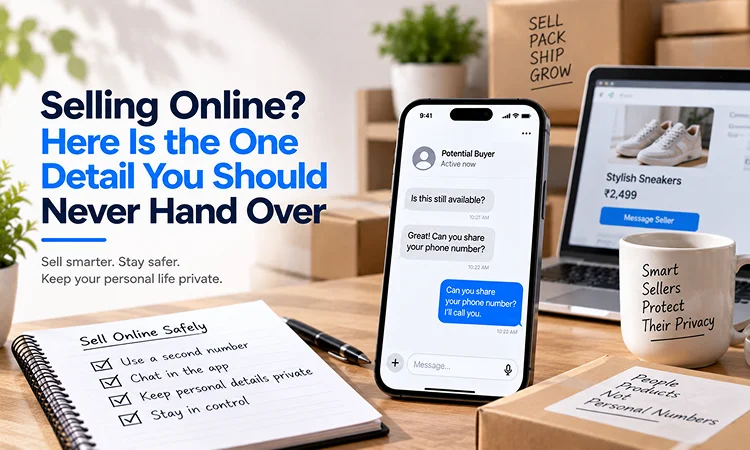
You have listed the item. A buyer messages you. After a few back and forth questions about condition and price, they ask for your number “to sort out pickup easier.”
It feels like the practical next step. Most of the time, it is exactly that, nothing more than two people arranging a handover.
But this single, ordinary moment is also where a meaningful share of marketplace problems begin, and it has very little to do with how careful or experienced a seller you are. It has to do with one piece of contact information that ends up traveling much further than the sale itself.
The Scale of This Problem Is Bigger Than Most Sellers Realise
Peer to peer selling has grown enormously, and so has the volume of bad actors working within it. The Federal Trade Commission reported a 38 percent rise in social media marketplace fraud cases between 2024 and 2025, with Facebook Marketplace accounting for the largest share of those reports. The average reported loss exceeded 800 dollars per victim, and that figure only reflects people who actually filed a report, which most victims do not do.
This is not a reason to stop selling online. It is a reason to be specific about which details you hand over, and when.
Norton’s own guidance on Marketplace safety is direct on this exact point: sellers should avoid giving out their personal phone number, because it can be used for phishing, harassment, or intercepting security codes, and in some cases for identity theft or unauthorised account access.
That last part is the one most sellers have never considered. Your phone number is not just a way for someone to call you. It is often the same number tied to your bank’s two factor authentication, your email recovery, and other accounts that have nothing to do with the jumper you are trying to sell.
Why Buyers Ask for a Number in the First Place
Most of the time, this request is completely innocent. Coordinating a pickup time over text genuinely is easier than messaging back and forth through an app’s chat window, especially for last minute changes or finding a specific meeting spot.
The difficulty is that this exact normality is what makes it such an effective opening for the small minority of buyers who are not asking for innocent reasons. Because the request is so common and so reasonable sounding, almost nobody pauses to question it, which is precisely why it works as an opening move for harassment, scams, or simply collecting contact details that get reused or sold on elsewhere.
You do not need to treat every buyer with suspicion to protect yourself here. You just need a way to hand over a working number that does not carry the same downstream risk if the conversation turns out to be one of the exceptions.
What Actually Happens After You Give Out Your Number
Most sellers assume the worst case is an annoying buyer who will not stop messaging. That does happen, and it is frustrating, but it is rarely the most serious outcome.
A phone number connected to a marketplace listing can be used to attempt SIM swap fraud, where someone contacts your mobile carrier pretending to be you, using your number itself as proof of identity to request a replacement SIM card. If this succeeds, your number, and anything tied to it, including banking apps and two factor codes, can be redirected to the attacker’s device instead of yours.
It can also simply persist far longer than the transaction itself. Long after the sale is done and the item has changed hands, your number remains saved in a stranger’s phone, and there is no way to know what happens to it from there, whether it gets passed along, stored in a contact database, or just sits there indefinitely.
We cover the broader pattern of how a single shared number circulates and resurfaces in our blog on how one signup turns into years of marketing texts, which applies just as much to a Marketplace buyer as it does to a website signup form.
The Simple Fix That Does Not Make You Seem Difficult
Here is the part that makes this genuinely easy to solve rather than just something to worry about.
A second phone number lets you do exactly what the buyer is asking for, a real, working number they can text or call to sort out pickup, without that number being the one connected to your bank, your family, and everything else in your life. It functions completely normally. The buyer dials it, it rings. They text it, it arrives. There is nothing about the experience on their end that signals it is anything other than your number.
If the transaction goes smoothly, which it does the overwhelming majority of the time, nothing about this matters at all. If it does not, if the buyer turns out to be the rare exception who keeps messaging after the sale, asks for money up front, or becomes aggressive over a return, you are not stuck managing that fallout on the same number your mother calls you on.
You can see exactly how Second Line Number is built for this kind of everyday separation on our features page.
→ Get a second number for selling, so your real one never has to be on the line
Practical Habits for Safer Selling, Beyond the Phone Number
A phone number is the detail this blog is focused on, but it sits alongside a few other habits that meaningfully reduce risk for anyone selling regularly online.
Meet in a public, well lit location for any in person handover, ideally somewhere with other people around, such as a supermarket car park or a busy café. Avoid inviting buyers to your home unless you already know them well.
Treat payment screenshots as unverified until you have personally checked your own account and confirmed the funds have actually landed. Fake payment confirmation screenshots, created in seconds with free editing tools, are one of the most common tactics reported across Marketplace, Vinted, and Depop in 2026.
Keep the conversation inside the platform’s own messaging system for as long as possible before a pickup needs to be arranged. Platforms like Facebook, Vinted, and Depop can review in app messages if a dispute arises, but they cannot see or help with anything that happened over a personal phone number once it leaves their system.
Trust your instincts if a deal feels rushed or oddly insistent. Buyers pushing hard for your number, your address, or immediate payment outside the platform before any real conversation has happened is worth treating as a signal to slow down, not speed up.
What to Do If a Buyer Will Not Stop Contacting You
If a sale has already gone through and a buyer keeps messaging afterward, the same number you used for the listing means you can simply stop using it, or let it go quiet, without affecting your actual phone at all.
If you already shared your real number before reading this and the contact has become unwanted, our blog on why blocking alone does not solve the problem walks through what to do next, since the situation and the underlying fix are largely the same regardless of how the contact started.
If at any point a buyer or seller asks for payment information, banking details, or anything beyond a standard platform supported payment method, treat this as a serious red flag and stop the conversation. This pattern shows up repeatedly across reported Marketplace, Vinted, and Depop scams and is rarely, if ever, part of a legitimate transaction.
Frequently Asked Questions
Is it safe to give my phone number to a buyer on Facebook Marketplace?
It carries more risk than most sellers realise. Norton’s official Marketplace safety guidance specifically advises against sharing your personal number, since it can be used for phishing, harassment, or attempts to intercept security codes tied to other accounts. Using a separate number for buyer communication avoids this risk while still allowing normal calls and texts for arranging pickup.
What is the biggest risk of sharing my number with an online buyer?
Beyond unwanted contact after the sale, the more serious risk is a phone number being used in an attempted SIM swap, where someone uses your number to convince your mobile carrier to issue a replacement SIM in their name. This can give them access to two factor authentication codes and other accounts linked to that number. This is uncommon but serious enough to be worth avoiding by default.
How common are scams on Facebook Marketplace, Vinted, and Depop?
Marketplace fraud has grown significantly. The Federal Trade Commission reported a 38 percent increase in social media marketplace fraud cases between 2024 and 2025, with an average reported loss of over 800 dollars per victim. Many victims never file a report, so actual figures are likely higher than what is publicly recorded.
Will using a second number make buyers suspicious of me as a seller?
No. A second number works exactly like a normal mobile number for calls and texts, and there is nothing visible to a buyer that distinguishes it from a primary number. Many frequent sellers use a separate number specifically for marketplace activity as a standard precaution, not as a reaction to any particular concern about a specific buyer.
What should I do if a buyer keeps contacting me after the sale is finished?
If you used a second number for the listing, you can simply stop using that number or let it go quiet without any impact on your actual phone. If you shared your real number, stop responding entirely, block the contact across every platform they could reach you on, and avoid engaging further, since any response can be read as an opening to continue contact.
→ Start your free trial with Second Line Number and sell online without exposing your real number