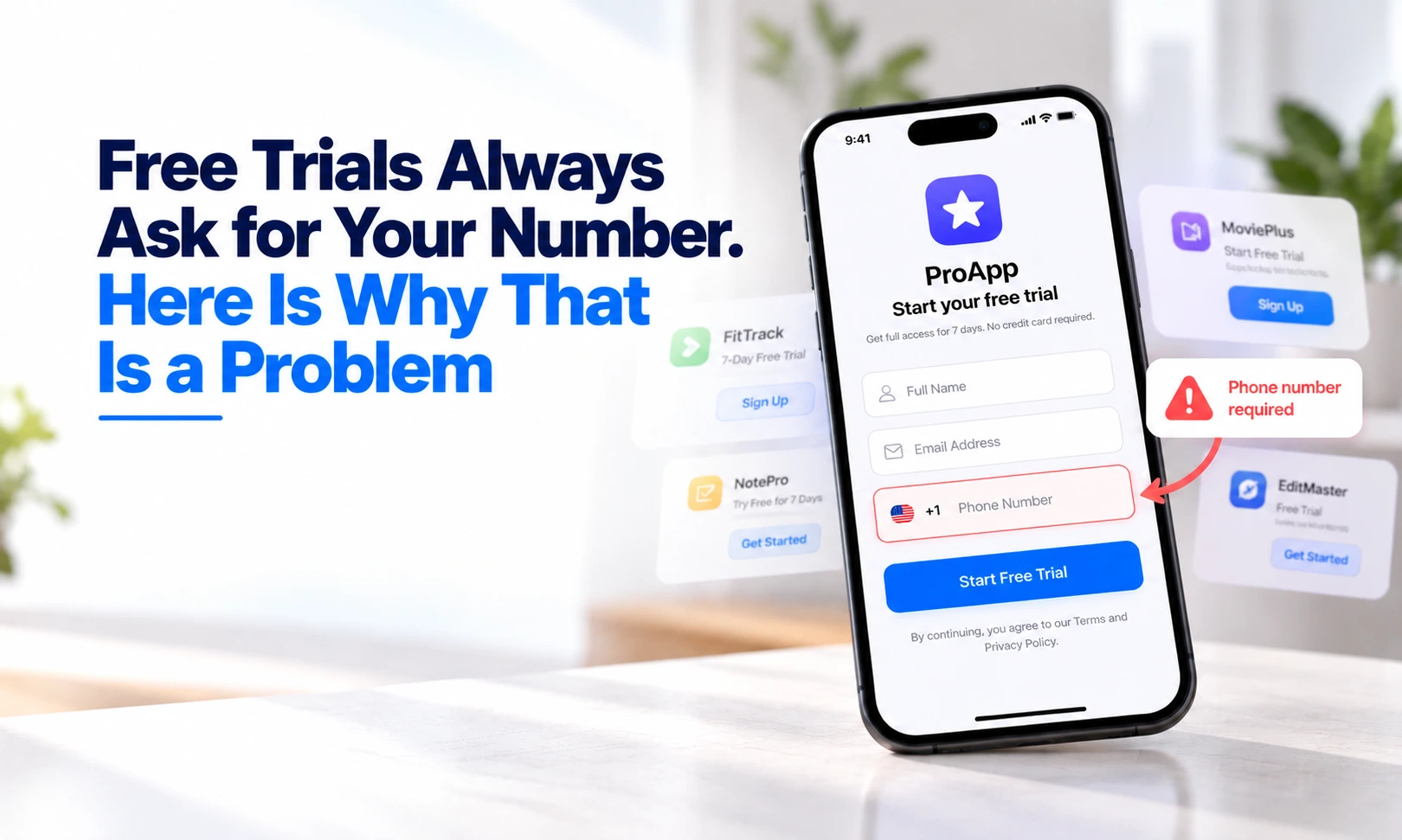
The free trial is one of the most effective commercial tools ever invented. A short window of access, no upfront cost, cancel any time. It works on virtually everyone, not because people are careless but because the offer is genuinely good. Try something for free before committing.
What most people do not think about during signup is what the trial itself costs in terms of data.
Before you get the free access, you hand over your name, your email, your payment details if a card is required, and your phone number. The trial period is finite. The data you submitted is not.
Understanding what free trial operators and subscription boxes do with a phone number explains why this particular piece of information is worth more care than most people give it.
Why Free Trials Ask for Your Phone Number
There are two stated reasons and one unstated one.
The stated reasons are verification and fraud prevention. Requiring a phone number with SMS verification reduces the ability to create multiple fake accounts to abuse a trial repeatedly. This is a real problem: Stripe’s fraud team found a 6.2 times increase in abusive free trials across their network between November 2025 and February 2026, driven primarily by bad actors using automation to harvest trial access. From the business perspective, phone verification is a legitimate fraud control.
The second stated reason is security and account recovery. If you lose access to your account, the phone number provides a recovery route. Again, a genuinely legitimate use.
The unstated reason, which is not always illegitimate but is rarely disclosed clearly, is that a verified phone number attached to a real person who has expressed interest in a product or service is a commercially valuable piece of data. It can be used for SMS marketing directly, it can be shared with commercial partners, and it can be sold to data brokers who add it to profiles built from other sources.
The DMCC Act in the UK, which came into force in Spring 2026, introduced new protections around subscription traps including requirements that cancellation must be as easy as signup and that renewal reminders must be sent before charges begin. These protections address the billing side of subscription traps. They do not address what happens to the contact data collected during signup.
The Data Problem With Subscription Boxes Specifically
Subscription boxes are a specific category worth examining because they collect more personal information than a typical free trial and they do so in a context where users are focused on the product rather than the data.
Signing up for a subscription box typically requires name, delivery address, phone number, email address, product preferences, and payment details. The address and phone number combination is particularly valuable because it connects an identity to a physical location and a contact point.
DoNotPay’s analysis of UK subscription box free trials is explicit: the required information includes mobile number alongside name, address, and card details. The mobile number is presented as a standard contact requirement. What happens to it after the trial depends entirely on the company’s data practices, which vary significantly and are disclosed in terms most subscribers never read.
The companies running subscription boxes range from well-established brands with reasonable data governance to small startups with limited security infrastructure. A phone number handed to a startup that subsequently closes or is acquired enters a data situation the original user has no control over.
There is also the churn dynamic. Subscription boxes have high trial-to-retention attrition. Most people who sign up for a free box do not become long-term subscribers. The company has a phone number. The relationship has ended. What happens to the number is now entirely the company’s decision.
What Happens After the Trial Ends
When a free trial expires, there are three possible outcomes for the user: they subscribe, they cancel, or they forget to cancel.
In the first case, the relationship continues and the phone number serves its stated purpose.
In the second case, the user has cancelled but the data they submitted during signup remains. Most companies retain customer data for extended periods after account closure, citing reasons including legal compliance, fraud prevention, and business analytics. The phone number remains in their systems.
In the third case, the automatic charge that follows an unconverted trial is itself the source of renewed contact. Calls about the failed payment, texts about the expiring trial, follow-up from customer retention teams: all of this uses the phone number submitted at signup.
Beyond the company itself, third party systems used by subscription businesses, email marketing platforms, SMS delivery services, analytics tools, and payment processors each hold some portion of the subscriber’s contact data. A phone number submitted to one subscription box service may sit in three or four third party systems even before the company’s own data sharing practices are considered.
One in five consumers admitted in a 451 Research 2025 survey to creating multiple accounts to access promotions repeatedly. This is a response to a system where the data exchange feels one-sided. Using a second number for free trial signups is a more effective version of the same instinct: limit what the trial operator gets in exchange for the access they are providing.
The Practical Solution
A second phone number used for free trials and subscription box signups receives the SMS verification code, receives any service notifications during the trial period, and receives whatever marketing and retention contact follows after the trial. The real personal number receives none of it.
The trial functions identically from the user’s perspective. The verification code arrives. The account is created. The trial begins. The only difference is which number sits in the company’s database going forward.
If the service turns out to be worth subscribing to, the account can be updated to a real contact number at that point, once the user has decided the relationship is worth a permanent contact detail.
If it turns out not to be worth subscribing to, the cancellation is clean and no marketing follow-up reaches the real personal line.
This is especially useful for the category of signups done on impulse or to access specific content, where the intent was never long-term engagement. A second number for those signups keeps the real number reserved for the commercial relationships that are genuinely chosen rather than briefly sampled.
You can see how Second Line Number works for this exact use case on our features page.
→ Get a second number and use it for every free trial and subscription box signup
The UK Subscription Trap Context
For UK readers, it is worth knowing that the DMCC Act 2024, with provisions coming into force in 2026, creates new legal requirements for subscription businesses. The easy exit mandate requires that cancellation be as simple as signup. Renewal reminders must be sent before charges begin after a trial. New cooling-off rights apply when a free trial converts to a paid subscription.
These protections improve the commercial terms of trial signups considerably. They do not alter the data collection that happens at the point of signup. Your phone number is still collected during the trial period and what happens to it after cancellation remains governed by the company’s own data retention and sharing policies.
The new rules make subscription boxes fairer commercially. A second number makes the data exchange fairer from your side.
Our blog on how one signup creates years of marketing contact covers the downstream data sharing mechanism that applies to subscription signups exactly as it applies to other one-off contact submissions.
If you have questions about how Second Line Number works for subscription and trial use, our support centre is available or you can contact us directly.
→ Download the Second Line Number app and protect your real number from trial signups
Frequently Asked Questions
Why do free trials require a phone number?
Free trials ask for phone numbers for two main stated reasons: to prevent the same person from creating multiple accounts to abuse the trial repeatedly, and to provide an account recovery route. There is also a commercial reason rarely disclosed clearly: a verified phone number attached to someone who has expressed product interest is valuable for direct marketing, data sharing with partners, and sale to data brokers.
What happens to my phone number when a free trial ends?
It depends on the company. Most retain customer data for extended periods after a trial ends, including after cancellation, citing legal compliance and business analytics. The number may also sit in third party systems used by the company for email marketing, SMS delivery, analytics, and payment processing. In the UK, the DMCC Act 2026 improved cancellation rights but did not change data retention practices after cancellation.
Is it safe to give my real phone number for a subscription box free trial?
The immediate risk is low. The longer term risk is the number entering data systems you cannot see or control, being shared with marketing partners, and generating ongoing contact after the trial ends. Subscription boxes also collect a delivery address alongside the phone number, creating a more complete personal profile than many other trial signups. A second number limits this exposure without affecting the trial experience.
Can I use a second number to sign up for free trials?
Yes. The SMS verification code arrives at the second number normally. The account is created. The trial functions identically. The difference is that the number in the company’s database is not your permanent personal number. If you decide to subscribe, you can update the account to a real contact at that point.
Does the new UK DMCC Act protect me from subscription data problems?
The DMCC Act 2024, with provisions effective from 2026, creates better cancellation rights and renewal notification requirements. It does not regulate what happens to contact data collected during a trial after the trial ends. Data retention and sharing practices remain governed by individual company privacy policies and UK GDPR, which gives you rights to access and in some circumstances delete your data but does not automatically prevent it being shared while you remain a subscriber or a former subscriber.
→ Start your free trial with Second Line Number and use it for every future subscription signup