You have been chatting for a few days. It is going well. Then comes the message: “Should we move this to texting?”
It feels like a good sign. Like the relationship is progressing. And most of the time, it probably is.
But this is also the exact moment where things can quietly go wrong, and almost nobody warns you about it until after it has already happened to them.
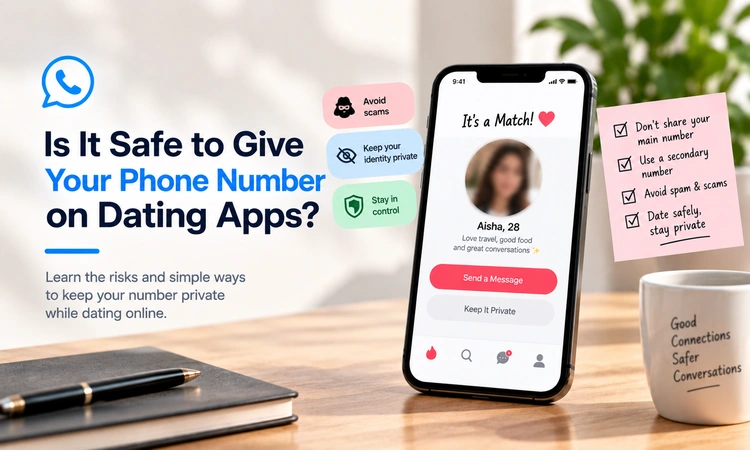
This is not a post telling you dating apps are dangerous or that you should never share your number. It is about understanding what you are actually handing over when you do, so the decision is yours and not just something that happens because saying no felt awkward.
Why “Just Move to Texting” Feels So Normal
Dating apps want you to leave the app eventually. That is the whole point. So asking for a number partway through a conversation is completely standard behaviour and most of the time it means exactly what it looks like.
The problem is that this normality is also what scammers and people with bad intentions rely on. Because it is such a common, expected step, almost nobody questions it. Asking “why do you want my number” would feel paranoid or rude. So most people just give it.
Fox News covered a case where someone on Tinder was guided through what felt like a completely ordinary conversation before being asked to move to WhatsApp. The pattern only became obvious afterward, once the questions started repeating in a scripted way and the requests for personal information began.
The lesson here is not that you should be suspicious of everyone who asks for your number. It is that the request itself tells you nothing. The context around it does.
What Someone Can Actually Do With Just Your Phone Number
This is the part that surprises most people, because a phone number feels like such a small, harmless thing to hand over.
A phone number is often enough to find someone’s general location. There are tools, some free and some paid, that can take a mobile number and return a rough address or area. You do not need to be a hacker to access this. Several apps and websites do it for anyone willing to pay a small fee.
Your number can also connect to other parts of your identity. If you have ever used the same number for a food delivery account, a loyalty card, or a social media profile that was not set to private, a determined person can sometimes trace a path from your number to your full name, your other accounts, and sometimes your family members.
There is a more serious risk that gets far less attention than it should. Scammers have used phone numbers to contact a victim’s mobile carrier directly, claiming to have lost their SIM card, and using the number itself as proof of identity to request a replacement SIM. If this works, the number transfers to their device. From that point on, any account using that number for two factor authentication, banking apps, email recovery, anything, can potentially be accessed by them instead of you.
This does not happen often. But it has happened, and the fact that it is even possible is reason enough to think about who gets your real number and when.
Why “I Can Just Block Them” Is Not Quite the Safety Net It Sounds Like
A lot of people share their number with the thought that if it goes wrong, blocking solves it. Blocking does help. But it has limits worth knowing before you rely on it as your only plan.
Blocking stops a specific number from reaching you going forward. It does not undo what someone already has. They still know your number. They still potentially know your name, depending on what you have shared. If they were collecting information with bad intent, blocking happens after that information is already theirs.
We go into this in more depth in our blog on why blocking does not actually solve the problem, which covers the same pattern in a different context but the underlying issue is identical. Blocking manages a symptom. It does not undo exposure.
The Honest Middle Ground: You Do Not Have to Choose Between Trust and Safety
Here is where most advice on this topic gets it wrong. Most articles tell you either to never share your number, which feels paranoid and genuinely makes dating harder, or to just trust your gut, which is not really a safety strategy at all.
There is a third option that almost nobody talks about clearly enough.
A second phone number lets you do exactly what you would normally do, move the conversation off the app, exchange a number, start texting properly, without your real number being the one that gets handed over. It works exactly like a normal number. Calls connect. Texts arrive. To the person on the other end, there is no difference at all.
The difference only matters if things go wrong. If the person turns out to be someone you would rather not have contacted you again, you can stop using that number, or simply let it go quiet, without your actual phone number, your real contacts, and everything tied to it being involved at all.
You can see exactly how this works on our features page, but the short version is that it removes the binary choice between seeming distant and being exposed.
A Practical Way to Think About Timing
There is no universal rule for exactly when sharing a number becomes appropriate, because every situation and every person is different. But a few practical markers tend to hold up well.
If someone is pushing hard to get your number very early, before a real conversation has developed, that pace itself is worth noticing. Genuine interest is rarely in a rush.
If the conversation starts to feel scripted, with questions that do not quite follow from what you just said, or personal backstory that seems to arrive on cue, slow down regardless of how the number question came up.
If you have met in person already, even briefly and in a public setting, the calculation changes considerably. A face to face meeting, however short, adds a layer of accountability that a chat window does not have.
None of these are guarantees. They are just better information than “it felt fine to give it to them,” which is the only thing most people are working from when they decide.
What This Looks Like in Practice
Say you match with someone on Hinge. The conversation is good. After a few days they suggest swapping numbers to text properly. You are not against it, you just do not know them yet.
Instead of handing over your real number or feeling pressured to decide on the spot, you give them a second number that exists for exactly this purpose. The conversation moves forward exactly as it would have. If it turns into something real, nothing changes, you keep talking. If it does not, or if something about the dynamic shifts and feels wrong, you are not stuck managing the fallout on your actual phone number that your family, your work, and everyone else who matters also has.
This is not about expecting the worst from people. Most matches are exactly who they say they are. It is about not needing to bet your real number on being right every single time.
→ Get a second number you can use for dating apps and anywhere else you are still building trust
If You Are Already Past This Point
If you have already shared your real number and something about the situation feels off, here is what actually helps.
Stop responding. Do not explain why, do not try to let them down gently, just stop. Any response, even a kind one, can be read as an opening to continue the conversation.
Block them across every platform where they could reach you, not just the one where the conversation has been happening.
If they have asked for money at any point, in any form, that is the clearest possible signal and you should stop all contact immediately and consider reporting the profile to the app itself.
If you are worried they may have enough information to find you in person, this is worth taking seriously rather than dismissing. Tell someone you trust what is happening and where the conversation has been taking place.
Our blog on what a second number actually gives you in terms of privacy is worth reading if you want to understand the realistic boundaries of what privacy tools can and cannot protect you from, since being clear eyed about this matters more than feeling falsely reassured.
Frequently Asked Questions
Is it safe to give my phone number to a match on Tinder, Bumble, or Hinge?
It depends entirely on context rather than the platform itself. Most exchanges are completely fine because most people on dating apps are genuine. The risk comes from a small minority who use the same casual, expected request to gather information they should not have. Using a separate number for early conversations removes the risk without requiring you to judge every match correctly in advance.
Can someone find my address just from my phone number?
Yes, in many cases this is possible using reverse lookup tools and services that connect phone numbers to public records, billing addresses, or linked accounts. This does not require advanced hacking skills. Several apps and websites offer this for a small fee. This is one of the main reasons people choose not to share their primary number with someone they have not met in person.
What is the SIM swap risk people mention with dating apps?
In rare but documented cases, someone who has obtained a victim’s phone number has contacted the victim’s mobile carrier, falsely claimed to have lost their SIM card, and used the number itself to request a replacement SIM in their own device. If successful, this can give them access to two factor authentication codes and other accounts linked to that number. This is uncommon but serious enough that limiting who has your real number is a reasonable precaution.
Will using a second number for dating apps seem suspicious to a match?
No. A second number functions exactly like any other mobile number for calls and texts. There is nothing about it that signals to the other person that it is not your only number. Many people use a separate number for dating, work, or online marketplaces simply as a matter of habit, not as a response to suspicion about any specific person.
Should I wait until we meet in person before sharing my real number?
Many people choose to keep conversations on a second number until trust has been established, which often includes meeting in person at least once. There is no fixed rule, but a face to face meeting in a public place adds a layer of accountability that text based conversation alone does not provide. After that point, many people feel comfortable transitioning to their real number if the connection continues.
→ Start your free trial with Second Line Number and date without giving up your real number