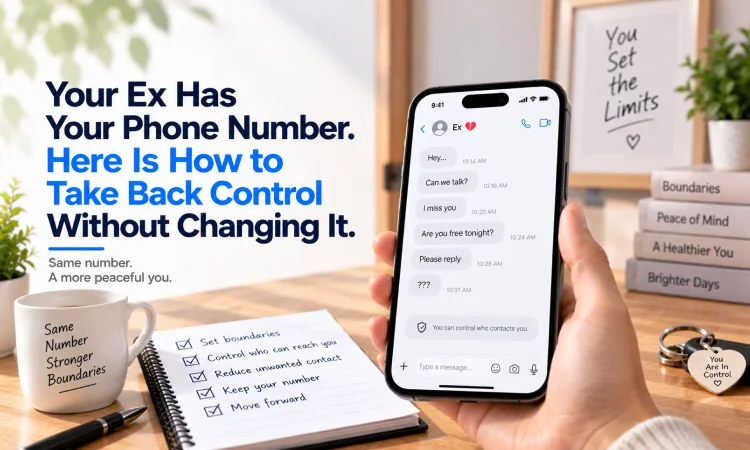
You blocked the number. Obviously. That is the first thing anyone does.
And then, probably within a day or maybe a few hours, a message came through from a number you did not have saved. Or it was not a call at all. It was a text through a friend who “just thought you should know“. Or a WhatsApp from an account that did not exist last week.
This is the part nobody warns you about. Blocking works on a number. It does nothing about a person.
If you are reading this, you have probably already tried the obvious things. This is not a post telling you to block them again. It is about why the standard advice keeps failing and what actually puts you back in control.
Why Blocking Your Ex Does Not Actually Solve the Problem
Here is something that took me a while to understand properly when looking into this: blocking is not a solution. It is a filter.
Think about what actually happens when you block a number. That specific string of digits stops working. That is it. The person behind it still has a phone. Still has access to free number apps. Still has a friend who might pass a message on. Still knows your number, your name, and your last known address if it got that far.
You have closed one door in a house with twenty doors. And they know the layout.
The deeper issue, and this is the bit the “just block them” advice completely misses, is that blocking puts you in a permanently reactive position. They act. You respond. They get a new number. You block it. Repeat. You are always one step behind, and they are the ones setting the pace.
What you actually need is not a better blocking strategy. What you need is for your real number to stop being a usable point of contact for people who should not have it. Those are two very different problems. We cover this in more depth in our guide on how to protect your phone number without changing it.
→ Get a second number so the next person you are unsure about never has your real one
What to Do Right Now: The Immediate Steps
If you are in this situation today, here is the order of actions that actually matters.
1. Document Everything Before You Respond or Block
Before you do anything else, screenshot every call log, text, and message. Note dates and times. This feels tedious when you are stressed, but it matters, both for your own peace of mind and if you ever need to show a pattern to anyone else.
Courts, employers, and support services all respond better to documented evidence than to descriptions. A list of 47 calls over two weeks is far more concrete than “They kept calling me.”
2. Make One Clear Statement Then Go Completely Silent
If you have not already told your ex explicitly that you do not want contact, do it once. Briefly, clearly, in writing. One message. Something like “Please do not contact me again.”
Then stop responding entirely. No replies, no reactions, not even to say stop messaging me. Every response, however firm, signals that contact produces a reaction. That is often exactly what unwanted contact is designed to get.
Silence is not weakness. It is the only thing that removes the incentive.
3. Block Across Every Channel at the Same Time
Do not just block the phone number. Block on WhatsApp, iMessage, Instagram, Snapchat, TikTok, and any other platform where they could reach you. Do it all at the same time, not one by one over days.
If they get through on one channel while others are still open, the pattern continues. A single afternoon spent closing every door properly saves weeks of back and forth.
4. Tell One Trusted Person What Is Happening
Isolation makes this worse. Tell one person you trust, a friend, a family member, or a colleague what is going on. Ask them not to pass on information about you or share your whereabouts. If your ex makes contact through mutual people, those people now know not to relay messages or act as a go-between.
This matters more than it sounds. Many unwanted contact situations escalate through indirect routes precisely because those routes feel more socially acceptable than direct harassment.
Why They Keep Getting Through and How to Stop It
So why does contact keep getting through even after you have blocked them?
Usually it is one of a few things, and sometimes all of them at once.
The most obvious: new numbers. Free SIM cards cost nothing. Free VoIP apps cost nothing. Somebody motivated enough to keep contacting you will have a new number within ten minutes of being blocked. This is just how easy it is now, unfortunately.
The less obvious route is through people around you. A mutual friend who “just wanted to let them know you were okay”. A family member who did not realise they were being used as a relay. Your mum, who picked up a call from an unknown number and mentioned you had been unwell. None of these people are doing anything wrong. They just do not know what is happening. That is a conversation you might need to have.
The third one catches people off guard: old platforms. Not your main WhatsApp, not your Instagram messages, but the group chat from three years ago that you forgot existed. The shared notes app. A workplace Slack that still has their account in it. Contact coming through a channel you were not watching is genuinely unsettling when it happens. Worth going through your apps and thinking about which ones still connect you.
None of this has an easy fix at the blocking level. Because in all three cases the underlying problem is the same. They already have enough to reach you. Blocking routes does not change that.
It is also worth understanding how phone numbers persist online long after you think you have moved on. Our blog on how long your phone number stays linked to you online explains why this problem does not simply disappear with time.
The Longer-Term Fix: Separating Your Real Number from New Contacts
Your real number is permanent. Once someone has it, they have it. You cannot take it back.
But you can make sure the next person you are unsure about, the next date, the next person you meet at an event, and the next casual acquaintance never get your real number in the first place.
A second phone number gives you a working, real number you can use as your public-facing contact. It receives calls and texts exactly like a real number. To the person using it, it looks completely normal. The difference is that it is separate from your personal line. You can see exactly what Second Line Number offers and how it works on our features page.
If that contact becomes unwanted, you have options your real number does not give you:
You can silence it completely without affecting calls from people you want to hear from.
You can stop using it without changing your actual number or notifying anyone who matters.
You can keep your real number reserved for the people you genuinely trust.
This is not about deception. It is about having a layer between your permanent identity and people who have not yet earned access to it. If you want to understand exactly what level of privacy a second number gives you, our blog on privacy versus anonymity and what a second number actually provides is worth a read before you decide.
→ Download the app and get your second number in minutes
If the Contact Continues: When to Escalate
Most unwanted contact situations settle down once clear boundaries are set and maintained. But some do not, and it is important to know the line.
Consider reporting to the police if contact has continued after you made a clear request to stop. If they have called or messaged more than a handful of times after being blocked. If any message contains a threat, even an indirect one. If you feel physically unsafe or believe you are being followed or watched.
In the UK, repeated unwanted contact after a clear request to stop can constitute harassment under the Protection from Harassment Act 1997. You do not need to wait for a threat. A pattern of contact that causes distress or alarm is sufficient grounds for police involvement.
When you report, bring your documentation. Dates, times, screenshots, records of calls. That is where the evidence you collected in step one becomes important.
Consider a restraining order or non-molestation order if the behaviour persists after police contact. If you share children or property and contact is inevitable but being misused. If the situation has escalated beyond calls and messages into physical proximity.
You do not have to be in immediate danger to access these protections. Courts take patterns of unwanted contact seriously, especially when documented consistently.
What a Second Number Does Not Do: Being Honest About This
A second phone number is not a safety tool for someone already in immediate danger. If you feel physically threatened, the right response is the police, not a new number.
What a second number does is remove the vulnerability that makes unwanted contact so persistent in the first place. It gives you control over who reaches your real line by keeping your real line out of situations where it does not need to be.
For the situation you are already in, the steps above, document, go silent, block everywhere, and tell someone, are the immediate priority.
For every situation after this one, a second number means the next person you are uncertain about never has the key to your permanent contact in the first place. If you are wondering whether a second number is actually worth it for your specific situation, we answer that honestly in our guide on why it is worth getting a second phone number.
If you have any questions about how Second Phone Number works or whether it is right for your situation, our support team is available here or you can contact us directly.
Frequently Asked Questions
Can I stop my ex from contacting me without actually changing my number?
Yes, though it takes more than just blocking. Block across every platform at once, not one by one over days. Make one clear written statement asking for no contact, then do not respond again after that. Document everything. Screenshot it, note the date, and keep a record. The reason people say you do not need to change your number is that it does not really solve anything anyway because they already have it. What matters is what you do about new contacts going forward.
They keep calling from different numbers no matter how many times I block. Is there anything I can do?
Honestly, this is the most frustrating version of the problem because there is no single technical fix. What you can do is keep a log of every new contact attempt with dates, numbers, and times. This looks like nothing in the moment, but it builds into a clear pattern quite quickly. In the UK, repeated unwanted contact after you have asked someone to stop, even just a handful of times, can be enough to report to the police. You do not need dozens of calls. You need a documented pattern.
If I block someone on WhatsApp, can they still see my number?
Blocking stops them contacting you through the app. It does not delete your number from their phone. They still have it, and blocking just closes that particular route. This is why a second number is worth thinking about for new people you meet. Not because blocking does not work, but because once your real number is out there, you are always managing the situation rather than preventing it.
How many missed calls or messages count as harassment legally?
There is no magic number. What matters legally is whether the contact was unwanted, whether you made that clear, and whether it continued anyway. In the UK, a pattern of contact that causes distress is enough, and it does not require threats. Even a few calls from new numbers after you have asked someone to stop can be sufficient. If you are unsure, call 101, which is the non-emergency police line, and describe the pattern. They will tell you where you stand.
Should I respond to tell them to stop or just ignore everything?
One message, once. Something brief and clear in writing: “Please do not contact me.” Then nothing. Not another message, not a reply, not even a read receipt if you can help it. Every response, even an angry one, even one that just says stop, tells them that contact got a reaction. After that single message, silence is the most effective thing you can do. It feels wrong because it seems passive, but it is not passive. It is removing the incentive.
→ Protect your number going forward. Get Second Line Number today