Foreign signups with your home number create a cross-border data trail you can’t undo.
Most travel advice about phone numbers is about roaming charges.
Switch to a local SIM. Get an eSIM. Turn off data roaming.
That’s fine, as far as it goes. But there’s a bigger problem that nobody talks about – and it has nothing to do with your phone bill.
When you travel internationally and sign up for local apps, book local services, or hand your number to a hotel, transport company, or marketplace – you’re tying your home number to foreign databases, you’ll never be able to track or contact.
That data doesn’t disappear when your trip ends. It follows your home.
What Happens When You Share Your Number Abroad
Think about the last time you travelled and how many times your number changed hands.
A few common ones:
- Signing up for a local ride-hailing app (Grab, Bolt, Careem)
- Registering for a local food delivery service
- Booking a hotel or guesthouse that wants a contact number
- Signing up for a tourist SIM that links your number to a registration
- Using a local marketplace or classified site to arrange transport or accommodation
- Joining a tour WhatsApp group run by a stranger
Every one of these creates a record – in a foreign country, under foreign data laws, held by an organization you have zero ongoing relationship with.
And once you’re home, there’s no practical way to delete it, update it, or even know who still has it.
The Problem Isn’t Roaming. It’s Data Residency.
Roaming charges are a solved problem. eSIMs, international plans, and local SIMs handle that.
The privacy problem is different – and harder to fix after the fact.
Different countries have different data protection laws. Some are strong. Many are not. When you hand your home number to an app or service operating under a different legal jurisdiction, you lose the protections your home country’s laws might otherwise give you.
Your number gets stored in a database you can’t access, under regulations you’ve never read, by a company that may sell or share it with local marketing partners.
Six months later, you start getting international spam. WhatsApp messages from numbers you don’t recognize. Calls from +66 or +62 or +971 that you never asked for.
That’s your travel data trail, following you home.
Why Most Travelers Don’t Think About This
Because immediate concern is always practical.
Will my phone work? Can I get data? How do I call a cab?
You’re in a new city, figuring things out in real time. Signing up for Grab or booking a tuk-tuk through a local service feels like a small, necessary thing.
It is small. That’s exactly why it adds up.
By day three of a two-week trip, your home number may already be in five or six foreign databases. By the end of the trip, there are a dozen. And unlike a hotel room, you can’t check out and leave no trace.
The Simple Fix: Set Up a Second Number Before You Fly
This is the part most travel guides miss entirely.
You don’t need a new SIM. You don’t need to carry two phones. You don’t need to port your number or do anything complicated.
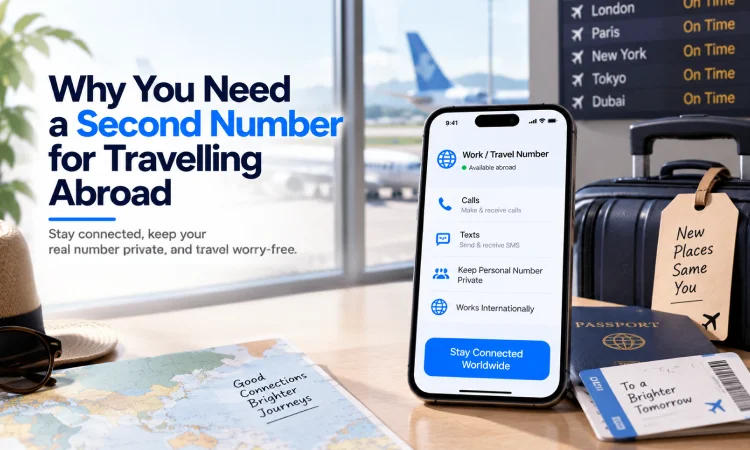
You just need a second number — one that you use for everything travel-related – that keeps your real number completely out of the picture.
With an app like Second Line Number, you can get a second number in under two minutes. You use it for:
- All local app registrations abroad
- Hotel and accommodation contact numbers
- Transport bookings and marketplace listings
- Tour group WhatsApp
- Any sign-up that requires a phone number but doesn’t need to be permanent
Your real number never touches any of it.
When you get home, if that second number starts attracting spam from your travels, it stays contained. Your primary number – the one linked to your bank, your family, your work – is clean.
The Roaming Cost
To be fair: cost is a real concern too, and a second number helps here as well.
If you’re using a second line app over Wi-Fi or mobile data, you’re making calls and sending texts through the internet – not the cellular network. That means:
- No per-minute international roaming charges
- No surprise bills when you get home
- Calls and texts work on any Wi-Fi connection, anywhere
It’s not a replacement for a local data SIM when you need internet access. But for calls and texts specifically, a second number of apps eliminate roaming costs entirely.
Most travelers know the eSIM trick. Fewer know that a second number app, used over hotel Wi-Fi, handles communication for free.
Before You Land: The Traveler’s Privacy Checklist
Here’s a simple framework for protecting your number on your next trip:
1. Get a second number before you travel
Set it up at home, before the trip, so it’s ready when you land. Don’t try to do this in an airport or while figuring out a new city.
2. Use your second number for all local app registrations
Grab, Bolt, Careem, local food delivery, tourist booking sites – use the second number for all of it.
3. Give hotels and guesthouses your second number
They don’t need your real number. A contact number for your stay is all they need – use the one that keeps your primary line private.
4. Keep your real number for your own use
Bank alerts, family calls, your home WhatsApp – these stay on your primary line. Your travel life and your real life stay separate.
5. Review and reset when you return
If your second number starts receiving spam from services you use abroad, you can swap it for a fresh one. Your real number is unaffected.
The Data Trail You Can’t Undo
Here’s the honest truth about international data.
Once your number is in a foreign database, you have almost no practical resources. GDPR applies only within the EU. PDPA applies in Thailand. PDPL applies in Saudi Arabia. Most countries outside the major regulatory blocs have limited data protection enforcement – and even where laws exist, making a deletion request to a company in another country you visited once is not realistic.
The only reliable way to protect your home number from cross-border data exposure is to never give it out in the first place.
A second number makes that easy.
Final Thoughts
Travelling is about experiencing new places. It shouldn’t mean permanently connecting your home identity to the databases of every app, hotel, and service you touched along the way.
The roaming advice is everywhere. The privacy advice isn’t.
Set up a second number before your next trip. Use it for everything local. Keep your real number for the people who actually need it.
That’s the travel privacy move nobody talks about – and it takes less than two minutes to set up.
FAQs
Do I need a second phone number when travelling abroad?
Not technically — but without one, every local app or service you sign up for abroad gets your home number, storing it in foreign databases under laws you can’t control. A second number keeps your real number out of the picture entirely.
Can I use a second number app abroad without roaming charges?
Yes. Apps like Second Line Number work over Wi-Fi or mobile data, so calls and texts don’t go through the cellular network. No roaming charges apply.
What’s the privacy risk of giving my real number to local apps when traveling?
Your number gets stored in foreign databases under local data protection laws, which vary significantly by country. Once stored, it’s very difficult to have it deleted. Spam and unsolicited contact often follow months after a trip.
Should I set up a second number before or after I land?
Before. Set it up at home when you have time. Trying to do it at an airport or in a new city adds unnecessary friction to your arrival.
Can I use my second number for WhatsApp while traveling?
Yes — you can register a WhatsApp account on your second number for use during the trip, keeping local contacts and groups separate from your personal account.
What happens to my second number when I come back from a trip?
It stays active — and so does any spam that found its way to it. If it becomes noisy, you can swap it for a fresh number within the app. Your primary number is never affected.
Is this different from just buying a local SIM?
Yes. A local SIM requires a new physical card, often in-country registration, and can complicate receiving messages on your home number. A second number app runs alongside your existing phone and number; no SIM swap is needed.