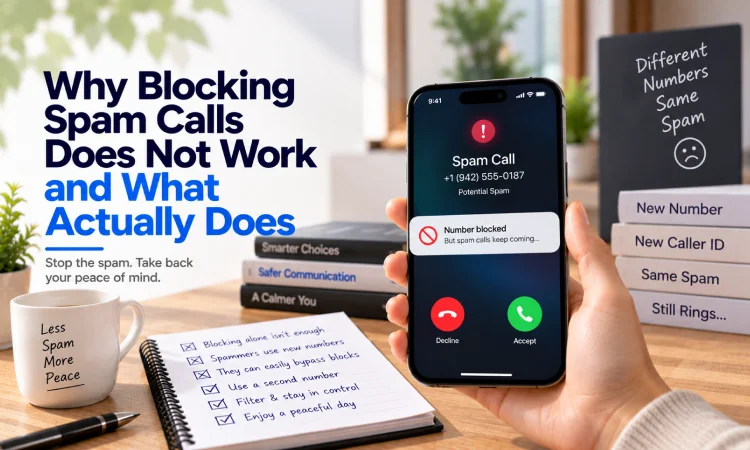
You have blocked the number. Obviously. That is what everyone does.
And then, probably before the end of the same day, a different number calls. Same recorded voice. Same opening line. Sometimes even the same area code as yours, which is not a coincidence.
You block that one too. And the next. And the one after that.
If you have been doing this for any length of time, you already know it is not working. The calls keep coming. The list of blocked numbers grows. Nothing actually changes.
This is not a complaint about spam calls. This is about why blocking them is the wrong approach entirely, what is actually happening behind the scenes, and what genuinely reduces the volume over time rather than just moving the problem around.
Why Blocking Spam Calls Does Not Actually Stop Them
Here is the thing nobody explains properly: when you block a spam number, you are blocking a number that was probably already being retired anyway.
Spam operations do not work the way most people imagine. They are not one person with one phone calling you repeatedly. They are automated systems making thousands of calls per minute across constantly rotating numbers. A single spam campaign might burn through hundreds of different numbers in a single day. The number that called you this morning may never be used again after noon.
So when you block it, you have successfully blocked a number that was already done with you. Meanwhile, the system that generated that call has already moved on to its next batch.
This is why the calls do not stop. You are playing a game where the other side has unlimited pieces and yours is limited to blocking one at a time.
There is also something called number spoofing, which makes the problem worse. The number that appears on your screen when a spam call comes through is often not the number the call actually originated from. It is a fake display number chosen to look local, familiar, or trustworthy. Blocking it does nothing because that number was never real in the first place. You are blocking a costume, not a person.
How Your Number Ended Up on Spam Lists
This is the part people rarely think about, and it matters more than anything else in this article.
Spam calls do not come from nowhere. Your number got on a list somewhere, and that list got sold, and then it got sold again, and now it is on several lists owned by people you have never interacted with.
Americans received around 2.56 billion robocalls every single month in 2025. That is not a typo. The scale of this industry is genuinely difficult to picture. Behind those calls is a network of data brokers who compile phone numbers from public sources, website signups, app permissions, purchase records, competition entries, and data breaches, and then sell those lists to anyone willing to pay.
The price per number is often a fraction of a penny. Which means your number, and mine, and everyone’s, is already out there in databases we will never see, attached to our name, our rough location, and sometimes our browsing behaviour and purchase history.
We wrote a full breakdown of exactly how this happens in our blog on how one signup turns into years of marketing texts. It explains the data sharing chain step by step and is worth reading alongside this one.
There is a second problem that most people do not realise. When you answer a spam call, even just to say “stop calling me” or to hang up after a second, you have done something valuable for the system. You have confirmed that your number is active and that a real person is on the other end. That information makes your number more valuable. Active, confirmed numbers sell for more. So answering, even angrily, often leads to more calls rather than fewer.
The same thing happens when you press any key to “opt out” of a robocall list. In a legitimate marketing context that might work. In a spam context, pressing any key confirms activity and sometimes triggers your number to be flagged as high value.
What Blocking Actually Does and Does Not Do
To be fair, blocking is not completely useless. It has a narrow, specific use.
If someone you know personally is calling you repeatedly and you want to prevent that specific person from reaching you, blocking works well. It is designed for that. One person, one number, permanent block.
For spam, it is close to useless because the fundamental mismatch is this: blocking is a one-to-one tool being used against a one-to-many problem. You can block one number at a time. Spam systems can generate new numbers faster than you can block them.
Carrier-level filtering is more useful than manual blocking. Most major networks now flag calls as “Spam Risk” or “Scam Likely” before they even reach you. This is done through systems that monitor calling patterns, not specific numbers, so they catch new numbers that are behaving like spam even before anyone reports them. Turning this on in your phone settings is worth doing if you have not already.
Third-party apps like Truecaller or Hiya work on a similar principle. They use crowdsourced reports from millions of users to identify numbers associated with spam before those numbers reach you. These are meaningfully more effective than manual blocking, though not perfect.
None of these fix the root problem. They filter. They do not stop your number from being on the lists in the first place. And as we explain in our guide on why using one phone number everywhere is dangerous, a single number tied to everything you do online is always going to be vulnerable.
What Actually Reduces Spam Calls Over Time
The only approach that genuinely reduces spam calls long-term is reducing how widely your real number circulates.
This sounds obvious once you see it. The reason spam calls keep coming is that your number is on lists. The only way to get off lists is to either get removed from them or stop getting added to new ones. Removal is slow and incomplete. Prevention is much more effective.
Think about every place you have given your phone number in the last few years. Every website signup. Every competition entry. Every loyalty card. Every app that asked for a number for verification. Every time you bought something online and the checkout asked for a contact number. Every time a shop asked for your number at the till.
Each of those is a potential entry point into the data broker ecosystem. Some of those businesses sell contact data directly. Others get breached and their customer data ends up circulating anyway. Some share data with partners as part of their terms and conditions, in language buried several paragraphs in that nobody reads.
You cannot undo the past. The numbers that are already out there are already out there. But you can change what happens going forward.
The Two Things That Actually Make a Difference
There are two practical changes that reduce spam call volume in a way that blocking simply cannot.
Stop Confirming Your Number Is Active
Do not answer calls from numbers you do not recognise. Let them go to voicemail. If it is someone legitimate, they will leave a message. If it is spam, silence is better than confirmation.
This feels counterintuitive. It feels rude, or like you might miss something important. But the reality is that answering a spam call is worse than missing a real call, because real callers leave messages and spam systems update their records.
Stop Giving Your Real Number to Low-Trust Sources
This is the most effective thing you can do going forward, and it is also the one piece of advice almost nobody in this space talks about because it requires a small change in habit.
A second phone number gives you a working, receivable number that is completely separate from your personal line. You use it for signups, verifications, marketplace listings, online purchases, competition entries, and anywhere else you would previously have given your real number without much thought. You can see exactly how Second Line Number works and what our features page.
If that number ends up on spam lists, the calls go there instead of to your real number. If the volume becomes annoying, you can manage or stop using that number without it affecting anyone who actually matters to you. Your real number stays clean because it was never in the ecosystem to begin with.
This is not about being paranoid or difficult. It is just recognising that your phone number is a piece of personal data with a long shelf life and treating it with the same basic caution you would apply to your home address.
Our guide on how to stop unwanted texts permanently covers the same principle applied to text spam and is worth reading if calls are not your only problem.
The Part That Nobody Mentions About Answering Unknown Calls
There is one specific behaviour that reliably makes the spam call problem worse, and it is worth naming clearly.
When a robocall system calls your number and you answer, it logs your number as “live”. Your number then gets moved to a higher value segment of the list, which gets sold at a higher price to more aggressive callers. You have, without meaning to, made yourself a better target.
The same is true if you engage with a spam text. Even replying with STOP to what appears to be a spam message can confirm your number is active if the message was not from a legitimate sender.
The correct response to any unexpected contact from an unknown source is nothing. No reply. No key press. No “Who is this?” Just ignore it entirely and let it time out.
A Note on Do Not Call Registries
In the UK, the Telephone Preference Service (TPS) allows you to register your number to opt out of unsolicited marketing calls. In the US, the National Do Not Call Registry does the same. These are worth registering with.
The honest caveat is that they work on legitimate marketers and have almost no effect on scam operations, which ignore these lists entirely. Registering is a five-minute task that reduces one category of calls. It is not a complete solution, and it is not designed to be.
If you want a fuller picture of how to protect your number across every channel without changing it, our guide on protecting your phone number without changing it covers every layer in one place.
If you have questions about getting started or want to know which plan suits your situation, our support centre has answers, or you can contact us directly.
→ Download the app and set up your second number today
Frequently Asked Questions
Why do spam calls keep coming even after I block them?
Blocking removes one specific number from reaching you, but spam operations rotate through hundreds or thousands of numbers automatically. By the time you block a number, it may already be retired. The calls continue because the system generating them simply uses a new number each time. Blocking is a one-to-one tool being used against a system that operates at a completely different scale.
How did spammers get my phone number in the first place?
Your number most likely entered the spam ecosystem through data brokers, who collect phone numbers from website signups, app permissions, public records, purchase histories, and data breaches, then sell them in bulk. A single signup on a low-quality website can result in your number being passed through multiple brokers before it reaches a spam operation. The process is largely invisible and happens without your knowledge.
Does answering a spam call make things worse?
Yes, in most cases. Answering a robocall confirms your number is active, which increases its value in data broker markets. Your number can then be placed on higher-value lists that are sold to more callers. The safest response to a call from an unknown number is to let it go to voicemail. Legitimate callers leave messages. Spam systems do not.
Does registering with the Do Not Call list stop spam calls?
It reduces calls from legitimate marketing organisations that comply with the rules. It has almost no effect on scam operations, which ignore these registries entirely. Registering is worth doing as one part of a broader approach but should not be treated as a complete solution.
What is the most effective way to reduce spam calls long-term?
The most effective approach is reducing how widely your real number circulates. Using a second phone number for website signups, app verifications, online purchases, and any other low trust context keeps your real number out of the data broker ecosystem. This does not fix the problem for numbers that are already on lists but it prevents the problem from growing and protects your real number going forward.