You can’t undo it. But you can stop the next one from reaching your real number.
It’s already done.
Maybe you responded to a message that seemed legitimate. Maybe you listed your number on a site, and someone used it in a way you didn’t expect. Maybe you handed it to someone in person, and something fell off later.
However, it happened — your real number is out there now, in the hands of someone you wouldn’t have chosen.
Here’s what to do.
Step 1: Don’t Respond to Any More Messages from Them
This sounds obvious. It isn’t.
The instinct when someone is harassing or scamming you is to respond – to tell them to stop, to ask how they got your number, or to say something you might regret.
Don’t.
Every response confirms two things:
- Your number is active
- Someone is reading their messages
That’s exactly what scammers and spam networks want to know. A response – any response – increases the value of your number and can trigger a wave of follow-up contact.
Ignore. Block. Don’t engage.
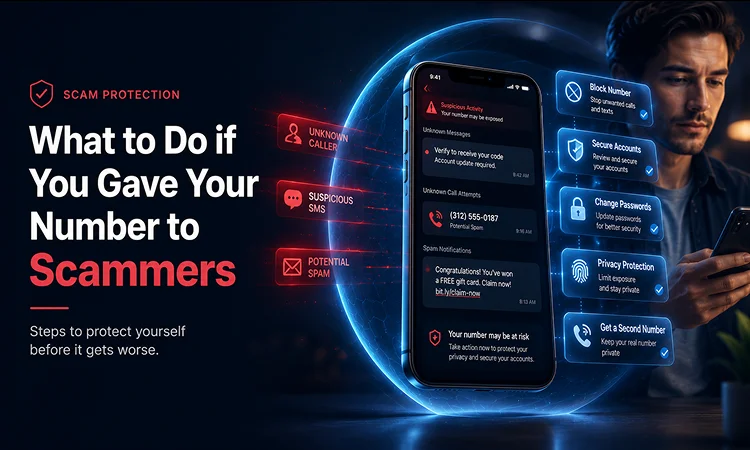
Step 2: Block the Number Immediately
Block them on every channel they’ve used to contact you:
- Block the number in your phone’s call and SMS settings
- Block them on WhatsApp if they’ve messaged you there
- Block on any other messaging app they’ve reached you through
Blocking doesn’t delete the fact that they have your number. But it cuts off the easiest path back to you.
Step 3: Report It
If the contact was part of an obvious scam, report it:
- India: Report to the National Cyber Crime Reporting Portal at cybercrime.gov.in, or forward the SMS to 1909 (the DND registry)
- UK: Report to Action Fraud at actionfraud. police.uk, or forward suspicious texts to 7726
- US: Report to the FTC at reportfraud. ftc.gov, or forward spam texts to 7726
- Australia: Report to Scam watch at scamwatch.gov.au
Reporting won’t undo what happened. But it creates a record, contributes to blocking patterns, and helps authorities track networks of scammers.
Step 4: Audit What Else They Might Know
Your phone number is rarely the only thing a scammer gets.
Think about how they reached you and what context came with it:
- Did you respond to a message that contained your name?
- Did the contact come through a platform where your profile has other details?
- Did you click a link before realizing something was wrong?
If you click a link, treat it seriously. Change the password on any account you accessed after clicking. Enable two-factor authentication on your email and key accounts if you haven’t already.
A phone number in the wrong hands is inconvenient. A phone number plus a compromised email account is a much bigger problem.
Step 5: Accept That Your Number Is Permanently Circulated — Then Protect Around It
Here’s the uncomfortable truth.
Once your number has been given to a scammer or a spam network, it moves fast. Numbers are bought, sold, and shared between lists. Within days, it may have been passed to multiple other operations.
You can’t pull it back.
What you can do is stop giving your real number anywhere new — and start using a second number as your public-facing line goes forward.
This is the actual fix. Not blocking. Not reporting. Those are responses. This is a prevention.
How a Second Number Changes Everything Going Forward
The reason scammers can keep reaching people is simple: most people only have one number. Once it’s compromised, there’s no clean line to retreat to.
A second number fixes that permanently.
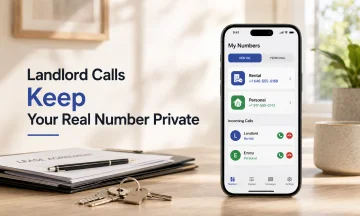
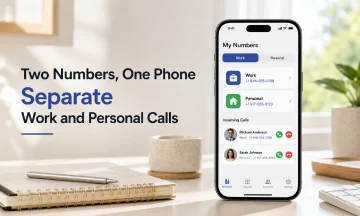
With an app like Second Line Number, you get a fully functional second number – real calls, real texts – that you use for anything outside your trusted circle:
- Online marketplaces and classifieds
- New contacts you haven’t verified yet
- App signups and loyalty programs
- Anything where you’re not 100% sure who’s on the other end
Your real number stays reserved for family, your bank, and people who’ve earned it.
If your second number ever gets into the wrong hands – or just starts attracting too much noise – you can swap it for a fresh one instantly. Your primary number is never touched.
The scammer got your real number because it was the only one you had to give. It doesn’t have to be the only one anymore.
What About Changing Your Number Entirely?
Some people go on this route. It’s understandable – but it’s also a significant disruption.
- Updating your number across every app, account, and contact takes hours
- Your bank, your WhatsApp, your work accounts, your family – all need updating
- And even then, if your habits don’t change, the new number ends up in the same situation eventually
Changing your number treats the symptoms, not the cause.
The cause is using your only number everywhere, for everyone. A second number solves that without the disruption of starting over.
What Scammers Actually Do with Your Number
Understanding this helps you stay alert in the coming days.
When scammers collect phone numbers, they are typically:
- Add them to bulk SMS lists for phishing campaigns
- Use them to attempt WhatsApp account takeovers via OTP hijacking
- Sell them to other spam operations
- Use them to look up associated accounts on social platforms
The WhatsApp point is worth paying attention to. If you receive an unexpected OTP code you didn’t request – especially on WhatsApp or a banking app – do not share it with anyone, under any circumstances. This is a common follow-up to number exposure.
Final Thoughts
You can’t take back what’s already been shared.
But you can stop the damage from compounding – by not engaging further, by reporting it, and by making sure your real number never has to be the number you give a stranger again.
The next time someone asks for your number, give them your second one.
It takes two minutes to set up. And it means that whatever happens next, your real number stays exactly where it should be – private, quiet, and yours.
FAQs
I gave my number to a scammer – what should I do first?
Stop responding immediately, block the number on all channels, and report it to your country’s cybercrime or fraud authority. Then audit whether any other information was exposed at the same time.
Can scammers do anything harmful with just my phone number?
Yes. They can add it to spam lists, attempt WhatsApp OTP hijacking, look up associated social media profiles, or sell it to other networks. Don’t underestimate exposure — take the steps above promptly.
Should I change my phone number after scam?
It’s an option, but a disruptive one. A better long-term solution is to use a second number as your public-facing line goes forward, so your real number stays protected even if a future contact turns out to be a scammer.
What does it mean if I get an OTP I didn’t request?
It likely means someone is attempting to access one of your accounts using your number. Do not share the code with anyone. Secure your WhatsApp and key accounts immediately by enabling two-step verification.
How do I stop scammers from texting me?
Block the number and report it. But blocking is reactive — it stops that specific sender, not future ones. Using a second number for public-facing situations prevents exposure of your real number in the first place.
Can a second number actually protect me from scammers?
Yes — because it keeps your real number out of situations where scammers typically find numbers. If a second number gets compromised, you will replace it. Your real number, and everything tied to it, stays clean.
How quickly can I get a second phone number?
With the Second Line Number, it takes under two minutes. Pick a number, and you’re ready to use it immediately for calls and texts.