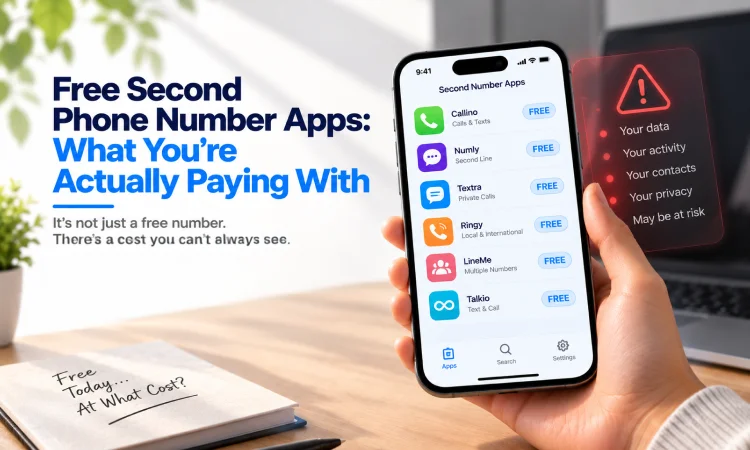
Free numbers cost you your data. Here’s what that means.
When you search for a second phone number, the first thing you see is a wall of free apps.
Free calls. Free texts. Free number.
And it’s tempting — especially when all you need is a quick second line for an online listing, a dating app, or a work group you don’t want bleeding into your personal life.
But here’s the question nobody asks before downloading: If the app is free, how does the company make money?
The answer matters more than most people realize.
How Free Apps Actually Work
Building and maintaining a phone number service isn’t cheap.
Carrier connections, SMS routing, infrastructure, customer support — all of it costs money. A lot of it.
So, when an app offers all of that for free, something else is covered by the bill.
In most cases, that something is you — or more specifically, your data.
Free second phone number apps typically make money through:
- In-app advertising — ads served based on your usage, behavior, and profile
- Data collection and sharing — selling anonymized (or not-so-anonymized) user data to third parties
- Upgrade pressure—free tiers designed to be just frustrating enough that you pay eventually
- Lead monetization—your contact patterns and call logs have commercial value
None of this is hidden, technically. It’s in privacy policy. The same one nobody reads.
What Free Apps Are Quietly Collecting
This is where it gets uncomfortable.
When you use a free second number app, you’re typically agreeing to let it access and store:
- Your call logs — who you called, when, and for how long
- Your message content—depending
- Your contacts — many apps request access to your full contact list
- Your location — often tied to ad targeting
- Your device identifiers — used to build a persistent profile even if you switch accounts
- Your usage patterns — when you’re active, how often you communicate, what times
Individually, these seem harmless.
But combined, they build a detailed behavioral profile of you — one that gets shared with advertising networks, data brokers, and “marketing partners.”
Sound familiar? It should. It’s the same ecosystem that’s been quietly flooding your primary number with spam for years.
Except now you’ve handed them a second data stream too.
The Irony of Using a Free App for Privacy
Most people download a second number app for privacy.
They don’t want strangers to have their real number.
But if the free app is harvesting your call logs, reading your messages, and selling your behavioral data — you haven’t gained privacy. You’ve just added another company to the list of people who know about your business.
You protected your number from a stranger. And handed your data to a corporation whose privacy practices you never checked.
That’s not a win.
What Paid Apps Do Differently
A paid second number app has a fundamentally different business model.
When you’re the customer — not the product — the incentive structure changes completely.
With a paid service like Second Line Number, the revenue comes from your subscription. That means:
- No ads—there’s no reason to profile you for advertisers
- No data selling—your call logs and message patterns aren’t a revenue stream
- No harvesting your contacts — your address book stays yours
- Clean, private infrastructure — built to serve you, not to monetize you
It’s a small but important distinction: a paid app wants you to keep subscribing. A free app wants to keep monetizing you.
Those two goals lead to very different products.
The Hidden Costs of Free Apps
Let’s be honest about what free actually costs:
1. Your Behavioral Data
Every call, every text, every contact — logged, stored, and potentially sold. Your habits have commercial value, and free apps know it.
2. Your Attention
Free apps survive on ads. Expect interruptions, upsell prompts, and banner ads inside the very tool you downloaded to simplify your life.
3. Your Number’s Reliability
A free number of pools are often shared across thousands of users. If a previous user burned that number with spam, you inherit its reputation. That affects WhatsApp verification, OTP delivery, and how recipients perceive your calls.
4. Your Security
Free apps often have weaker security practices. If their servers are breached, your message history, contact list, and call logs go with it.
5. Your Time
Free tiers are designed with friction. Limited minutes, expiring numbers, ads between calls — the “free” experience is deliberately degraded to push you toward paying. Except now you’ve already handed over your data.
When Does Free Make Sense?
To be fair — there are cases where a free number is fine.
If you need a number for a single, one-time verification — and you don’t care about privacy or reliability — a free temporary number of jobs.
But for anything ongoing:
- A second line for dating or online selling
- A work number you’ll use regularly
- A number for WhatsApp or messaging app registration
- Any situation where privacy is the actual goal
A free app defeats the purpose.
What You Get for a Few Dollars a Month
A paid second number isn’t expensive. Most quality services cost less than coffee a week.
For that, you get:
- A clean, dedicated number — not shared with other users
- No ads, no data harvesting — your conversations stay private
- Reliable SMS and call delivery — important for OTPs and WhatsApp verification
- The ability to swap your number if it ever receives too much spam
- Actual customer support — because you’re a paying customer, not a data source
Math is simple. You’re getting a second phone number to protect your privacy. Doing that with an app that monetizes your data is like installing a security camera that livestreams to strangers.
Final Thoughts
Free second phone number apps aren’t free. You pay with your data, your attention, your security, and often your time.
If privacy is why, you want a second number — and for most people, it is — then the tool you use to get that privacy needs to respect it.
A paid second number costs a few dollars. Free data harvesting costs you a lot more.
FAQs
Are free second phone number apps safe to use?
For one-time, throwaway use; they’re at low risk. For ongoing privacy — dating, selling online, work communication — they’re counterproductive. Most free apps collect and monetize your usage data.
Do free number apps sell your data?
Many do. Their privacy policies typically allow sharing data with “third-party partners” for advertising or analytics. Your call patterns, contacts, and message metadata are often included.
What’s the difference between a free and paid second phone number?
A paid app revenue comes from your subscription — so there’s no incentive to harvest your data. A free app revenue comes from monetizing your behavior through ads and data sharing.
Can free apps see my text messages?
Depending on the app and its privacy policy, yes — messages may be stored on their servers. Always check the privacy policy before using any messaging service.
Is a paid second phone number worth it?
If you’re using it for genuine privacy — protecting your real number from strangers, keeping work separate, or registering on WhatsApp — yes. The cost is minimal and the protection is real.
Why do free number apps ask for access to my contacts?
Primarily for ad targeting and data enrichment. Your contact list tells them a lot about who you are, where you live, and what you’re likely to buy.
How much does a quality second phone number cost?
Most reliable services, including Second Line Number, cost a few dollars a month — comparable to a single cup of coffee. Given what free apps cost in data, it’s a straightforward trade.