You walked into a dealership to look at a car. Maybe you took a test drive. Maybe you asked about finance options. Maybe you just browsed the forecourt and someone came out to take your details.
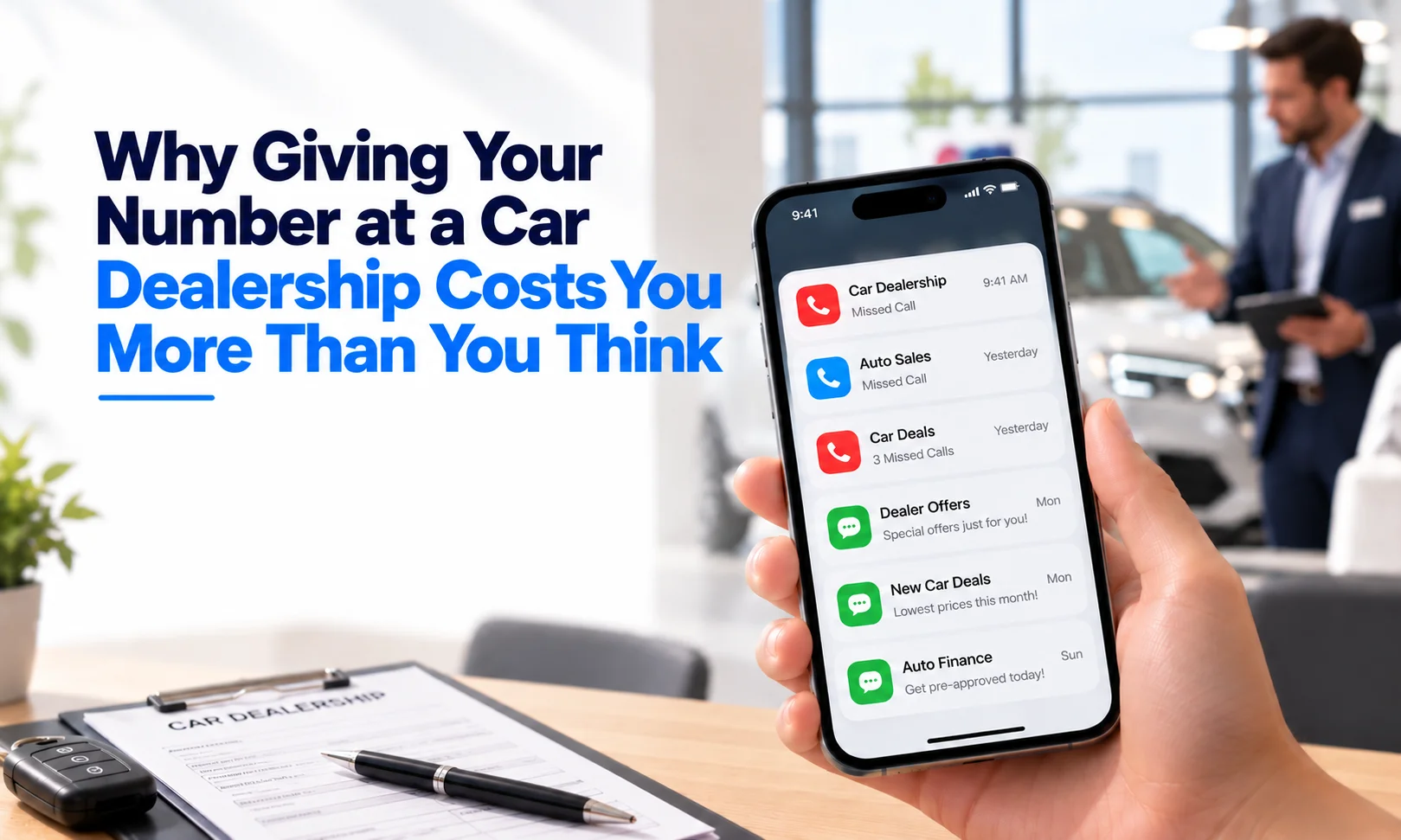
Your phone has not stopped since.
The dealership calls to follow up. Then an extended warranty company calls, somehow already knowing the make and model of a car you expressed interest in. Then a finance broker. Then an insurance company. Then someone claiming your vehicle warranty is about to expire on a car you have not even bought yet.
This is not a coincidence and it is not random targeting. It is the direct result of what happens to a phone number once it enters the car sales data ecosystem. And it starts from the moment you write your number on any form at or near a dealership.
How Dealerships Use Your Phone Number
Car dealerships are businesses built on follow-up. The standard sales training in automotive retail is explicit about contact frequency. Research from sales consultants cited by AARP found that the goal in many dealerships is to contact a potential customer around ten times over the first week after a showroom visit. The rationale is that the typical time from first contact to purchase is five days, and persistent follow-up is seen as the mechanism that converts interest into a sale.
This means that giving your number to a salesperson at a dealership is not the equivalent of giving it to any other business. It is entering a system specifically designed to use that number intensively over a short period and then potentially indefinitely afterward if you remain in their CRM as a customer prospect.
The problem does not stop at the dealership itself. Car dealers work with a network of finance providers, insurance companies, warranty providers, and vehicle service partners. When you apply for car finance at a dealership, your contact details go to the finance provider. When the finance provider processes your application, your details may be shared with credit reference agencies, insurance partners, and in some cases data brokers whose lists are purchased by automotive marketing companies.
In the US, state DMV records that include vehicle registration and contact details have in some cases been sold to third party marketing companies, providing another route by which ownership of a vehicle connects a phone number to subsequent marketing contact. The New York State DMV’s own guidance on data sharing acknowledges this practice.
The FCC has received enough complaints about car extended warranty robocalls specifically that they have published consumer guidance addressing them by name. YouMail’s robocall index has tracked auto warranty calls as one of the most consistent categories of spam call volume in the US for multiple years running.
The Finance Application Is the Highest Risk Moment
Of all the points at which a phone number is collected during a car purchase, the finance application carries the highest downstream risk.
A finance application collects a significant amount of personal information: full name, date of birth, address, employment details, income, existing financial commitments, and phone number. This package of information is commercially valuable because it identifies a person who is actively seeking credit for a large purchase. That profile is useful to many more industries than just the car finance one.
Dealerships often arrange finance through multiple lenders, submitting the same application to several providers to find the best rate. Each provider that receives the application receives the phone number along with it. Each provider may then share that data with their own commercial partners.
A thread on the myFICO forums captures this experience precisely. A user who got an auto loan found they were immediately receiving heavy volumes of spam calls from multiple numbers, all apparently related to having recently applied for car finance. Other forum members confirmed the pattern and noted that using a separate number for any financial form is the practical solution.
AARP’s consumer advice on avoiding unnecessary dealership callbacks specifically suggests setting up a separate phone number or email account just for car shopping, used only for that purpose and then set aside once the purchase is complete.
The Warranty Call Problem and Where It Actually Comes From
The extended warranty call is such a consistent experience after a car purchase or dealership visit that the FCC, FTC, and multiple consumer protection organisations publish specific guidance about it.
These calls are effective at what they do specifically because the caller often already knows what vehicle the target drives. This knowledge does not come from sophisticated hacking. It comes from commercially available vehicle data that connects registration records, dealership contact lists, and data broker files into a profile that includes the owner’s phone number alongside the vehicle details.
When a dealership sells a car, the registration data that follows typically includes enough information for marketing data operations to connect the new owner’s contact details to the vehicle. The time between purchase and first warranty call can be as short as a few days. The calls often continue for years regardless of whether the recipient ever engages.
Blocking individual numbers from these operations has the same limitation as blocking any spam call: the system has many numbers and generates new ones continuously. Our blog on why blocking spam calls does not work and what actually does covers this mechanism in detail. The only effective prevention is keeping the real number out of the system in the first place.
Using a Second Number for the Car Buying Process
The car buying process has a defined beginning and end. You research, you visit dealerships, you test drive, you apply for finance, you complete the purchase. After that, the commercial relationship with the dealership and its partners is largely concluded.
A second number used only during the car buying process contains all of the downstream contact within a channel that is separate from the real personal number. Dealership follow-up calls go there. Finance provider communications during the application process go there. Extended warranty calls that start arriving post-purchase go there.
Once the car is bought and the process is complete, the second number can go quiet. The warranty calls and marketing follow-up continue arriving at a number that is not connected to the real personal contact. The real number is unaffected.
This approach requires only one practical decision: use the second number on all forms filled in at or in connection with the dealership, and give the real number only to parties who genuinely need permanent contact access, such as the finance provider for the ongoing account relationship if finance is taken.
You can see how Second Line Number works for exactly this kind of time-limited use case on our features page.
What to Do If the Calls Have Already Started
If you have already given your real number at a dealership and the calls have started, blocking individual numbers will manage the immediate volume but will not stop new numbers being used. The approaches that actually reduce the long term volume are:
Register with the Telephone Preference Service in the UK or the National Do Not Call Registry in the US. This stops calls from companies that comply, which covers many legitimate automotive marketing firms even if it does not touch scam operations.
Report specific numbers to the FTC in the US or the ICO in the UK. Individual reports rarely produce immediate results but they contribute to enforcement patterns.
Do not engage with any call that references your vehicle but that you did not initiate. Do not confirm vehicle details, personal information, or any account numbers. Engagement confirms the number is live and active.
The calls typically reduce in frequency over several months as the data ages and becomes less commercially valuable. They rarely stop entirely because the data, once in circulation, continues to be used.
Our blog on why your number ends up in spam databases and how to reduce exposure covers the broader data sharing mechanism that sits behind this specific automotive pattern.
If you have any questions about getting a second number set up for a car purchase, our support centre is available or you can contact us directly.
Frequently Asked Questions
Why am I getting calls from warranty companies after visiting a car dealership?
Car dealership visits and purchases connect your phone number to commercial vehicle data that is shared with automotive marketing companies. Extended warranty and insurance firms purchase this data and use it to target vehicle owners directly. The FCC specifically names auto warranty calls as one of the most common robocall categories and publishes dedicated consumer guidance on them. The calls often start within days of a dealership visit or purchase and continue for months or years.
How does a dealership get my number to warranty companies if I only gave it to the salesperson?
Dealerships work with networks of finance providers, insurance partners, warranty companies, and data brokers as part of their commercial operations. Contact details collected during a sales interaction or finance application are shared within this network as a standard part of automotive retail. Additionally, vehicle registration data that follows a purchase can connect ownership details to contact information through commercially available data sources.
Is applying for car finance particularly risky for phone number privacy?
Yes. A finance application collects a comprehensive personal profile including phone number alongside income, employment, and credit information. This package is commercially valuable and is typically shared with multiple lenders during the application process. Each lender and their commercial partners may use the contact data for their own marketing operations.
Can I use a second number when buying a car without it causing problems?
Yes. A second number functions identically to a real number for all purposes in the car buying process, including dealership forms, finance applications, and insurance enquiries. The dealership and finance providers can reach you normally during the purchase process. Once the purchase is complete, the second number can be set aside and all subsequent marketing contact goes there rather than to the real personal number.
Will the calls ever stop on their own?
The volume typically reduces over several months as the contact data ages and becomes less commercially valuable. It rarely stops entirely because once data enters commercial circulation it is repeatedly resold and reused. Registering with the TPS or Do Not Call Registry reduces calls from compliant marketers. The only way to prevent the cycle is to use a different number for the purchase process so the real number never enters the automotive marketing data ecosystem.
→ Start your free trial with Second Line Number and use it for your next car purchase