If you’ve ever applied for a job online, you know the drill.
You upload your resume, fill out the contact fields, and wait. But then something happens that you didn’t anticipate: your phone starts ringing—a lot.
It’s not just the job you wanted. It’s recruiters from other agencies, “career coaches” you never signed up for, and occasionally, automated spam bots that somehow found your details.
Most candidates ask: “Should I use my personal phone number for job applications?”
The answer is: You can, but you might regret it.
In 2026, your phone number is more than a way to reach you—it’s a permanent entry in a recruiter’s database that outlives your job search.
Risk of Phone Number Exposure During Job Hunting
When you apply for jobs online, your contact information spreads across multiple platforms:
- Job boards
- Recruitment agencies
- Hiring databases
- Resume-sharing networks
- Internal HR systems
Once your resume enters an Applicant Tracking System (ATS), these databases are rarely “cleaned”, and that’s why they can remain there for months—sometimes even years.
Even after you’ve landed your dream role and settled in, your personal number remains “active” in their system.
This leads to the most common complaint among professionals: “Recruiters keep calling—how do I manage this?” Without separation, you are essentially leaving your front door open to the entire headhunting industry indefinitely.
Why Job Hunting Exposure is Different
Unlike a delivery order or a one-time sign-up, job hunting involves high-frequency contact.
- One application can lead to calls from three different junior recruiters at the same firm.
- Some “ghost jobs” exist solely to collect candidate data to sell to third-party marketing lists.
- If you are applying for remote or global roles, recruiters might call at 6:00 AM or 11:00 PM, blurring the lines between your personal life and work.
If you’re concerned about how your data is being handled by these platforms, it’s worth looking into how virtual numbers protect you from tracking. Using your primary phone number for job applications can create several issues.
The Hidden Problem With Using Your Personal Number
1. Ongoing Recruiter Calls
Recruiters often share candidate lists internally or across partner agencies. Your number may continue receiving calls from different companies.
2. Privacy Concerns
Your personal number may end up stored in multiple systems you don’t control. Once distributed, it’s difficult to remove it everywhere.
3. Workday Interruptions
Imagine starting a new job and receiving calls from recruiters during meetings or work hours. It can become distracting and awkward.
4. Mixing Personal and Professional Communication
Your personal phone number is usually connected to:
- Family calls
- Messaging apps
- Banking alerts
- Personal contacts
Adding dozens of recruiter calls to that mix can quickly become overwhelming.
A Smarter Strategy: Use a Separate Phone Number
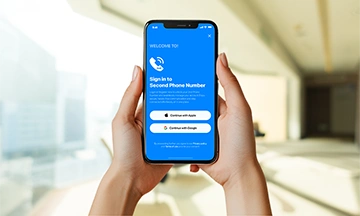
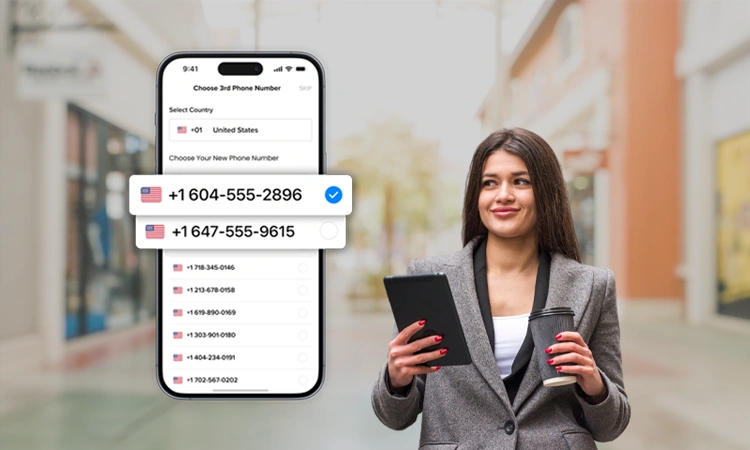
You don’t need to be invisible to recruiters; you just need a “buffer zone.” By using a dedicated Second Phone Number for your job search, you gain three major advantages:
- Work-Life Boundary: You know that every call coming into that line is job-related. You can choose when to “switch on” your candidate persona.
- Easy Muting: Once you sign an offer letter, you can simply silence that line or set an autoreply. Your personal life remains untouched.
- Data Protection: If a specific job board sells your data to spammers, your primary number—the one linked to your bank and family—stays safe.
For more on why keeping a single number for everything is risky, check out our guide on why using a single phone number everywhere is dangerous.
Professionalism vs. Privacy
Some candidates worry that a second number makes them look “unprofessional.”
In reality, recruiters don’t know (and don’t care) if a number is a primary SIM or an eSIM. They just want to reach you.
Using a professional second line actually makes you more organized.
You can set up a custom voicemail specifically for recruiters, ensuring you always sound like the perfect candidate, even if you can’t pick up the phone.
Final Verdict: Is it worth the switch?
Sharing your phone number is unavoidable during a job search.
But that doesn’t mean your personal number has to stay in recruiter databases forever.
Using a separate phone number lets you stay reachable for opportunities without exposing your main contact information for too long. For many job seekers, it’s simply a smarter way to manage the job-hunting process.
Ready to start your job hunt without the spam? Get your dedicated second number here.
FAQs
1. Should I use my personal phone number on my resume?
It is common but not recommended if you are applying to multiple public job boards. A second line protects you from long-term recruiter spam.
2. How do I stop recruiters from calling me after I find a job?
If you use your personal number, you must ask each agency individually to remove you. If you used a second line, you could simply deactivate it or silence its notifications.
3. Can I use WhatsApp for recruiter communication?
Yes. Many recruiters in 2026 prefer WhatsApp. You can run a second WhatsApp account on one phone; use your second number to keep your professional chats separate from family messages.
4. Do recruiters know ifI’musing a second line or eSIM?
No. To a recruiter, it appears to be a standard, reliable phone number.
5. What is the safest way to provide a phone number to job boards?
Use a dedicated secondary number that you can manage independently of your private life. This prevents your “digital identity key” from being stored in dozens of unverified databases.