When you rent a property, handing over your phone number feels like one of the least remarkable parts of the process. Of course your landlord needs a way to reach you. Of course the letting agent needs contact details. This is just how renting works.
And it is. You do need to be reachable. That part is not the issue.
The issue is what happens to that number over the course of a tenancy, who else ends up with it, and where it sits long after you have moved out. Because it is rarely just one person who ends up with it, and the tenancy ending does not mean the number goes away.
Who Actually Gets Your Number When You Rent
When you rent through a letting agent, your phone number does not go only to your landlord. It goes into the letting agent’s internal system first. From there it can be accessed by the agent who manages your property, the agent who did your referencing, the branch administrator, the property manager who handles maintenance calls, and anyone else in that office or network who has access to the tenant database.
If the agency uses a property management software platform, your number may sit in a system used across multiple branches or even across a parent company. Large letting agencies operate nationwide. Your number, submitted to a branch in one city, can end up accessible to staff in offices you have never visited.
Beyond the agency itself, your number typically gets shared with contractors. A landlord or agent who needs to arrange a repair will often pass your number to a plumber, an electrician, an inventory clerk, or a cleaning company directly. Under UK GDPR, giving a contractor a tenant’s phone number to arrange access is considered reasonable and proportionate, so this is not technically a breach. But the practical result is that your personal number is now stored in the contact list of a tradesperson you will likely never meet again, alongside no context about who you are or that you were ever a tenant.
What Happens After the Tenancy Ends
This is the part most tenants never think about until they start receiving calls from letting agents about new properties months or years after moving out.
Your number does not automatically get deleted when your tenancy ends. Letting agencies and landlords have legitimate reasons under data protection law to retain tenant data after a tenancy closes, including records related to deposits, reference disputes, and legal compliance. The specific retention period is not fixed by law and is left to the organisation’s own data retention policy, which varies enormously.
Under UK GDPR and the Data Protection Act 2018, you have the right to request deletion of your personal data once it is no longer needed for the original purpose. In practice, most tenants never exercise this right because they do not know it exists. Their number sits in a database indefinitely, sometimes being used for exactly the kind of marketing contact the regulations are meant to prevent.
The NetRent research on landlord data obligations notes that tenant data often remains active in agency systems far beyond its legitimate purpose, precisely because most tenants neither request deletion nor follow up when they do.
The Contractor Chain and Where Your Number Travels
Here is the chain that most tenants have no visibility into.
You give your number to the letting agent. The agent shares it with a contractor to arrange a boiler service. That contractor logs it in their own system as a customer contact. Their system may sync with a marketing platform. Their platform may sell or share contact data with partner firms in the home services sector.
You start receiving calls about boiler cover, home insurance, window replacement, or solar panels. You have no idea where they came from. The chain from your tenancy application to that call involved four or five separate organisations, none of whom you intentionally gave your number to.
This pattern, one point of data entry generating multiple downstream contacts, is identical to the pattern described in our blog on how one signup turns into years of marketing texts. The mechanism is the same regardless of whether the original entry point was a website form or a tenancy application.
The Right to Request Deletion and Why Most Tenants Never Use It
UK GDPR gives tenants the right to request that their personal data be erased once it is no longer necessary for the purpose it was collected. In a tenancy context, once any legitimate post tenancy obligations have been resolved, deposits returned and disputes settled, the personal number is technically no longer needed.
You can write to the letting agent or landlord directly requesting deletion of your personal data under Article 17 of the UK GDPR. They have one month to respond. If they decline on the basis of a legitimate ongoing interest, they must explain what that interest is. If they fail to respond or respond inadequately, you can escalate to the Information Commissioner’s Office.
This process exists and it works. The practical obstacle is that most people do not know about it, do not have the energy to pursue it once they have moved on, and see no immediate reason to act until the calls start arriving months later.
The Practical Alternative That Most Tenants Have Not Considered
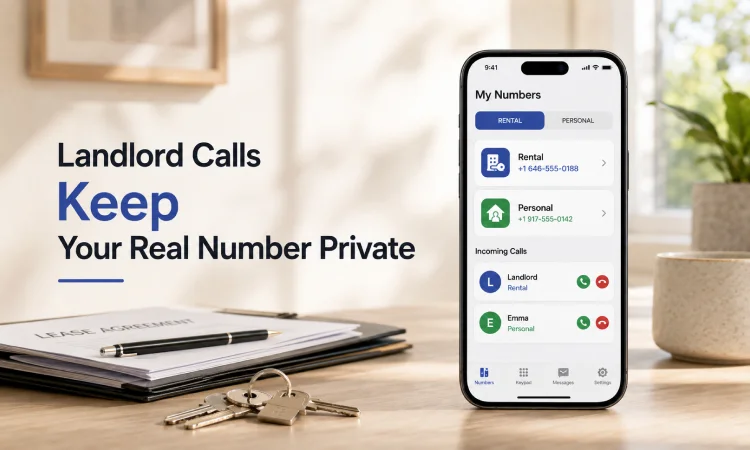
Here is something straightforward: you are not required to give your landlord or letting agent your primary personal number. You are required to give them a working number where they can reach you. Those are different things.
A second phone number that functions normally for calls and texts satisfies the letting agent’s requirement entirely. They can call you, you answer, the tenancy operates normally. If the contractor needs to arrange access, they call the same number and it works.
The difference only appears later. When the tenancy ends and the calls begin from home services companies, warranty providers, and letting agents marketing new properties, they go to a number that is not your personal line. If you move to a new property and want a clean start, you can stop using that number without anyone who matters being affected.
This is not a workaround or an evasion. A second number is a real, functional phone number. You are reachable. The tenancy works exactly as it should. You are simply not giving a third party permanent access to the same number your family, your employer, and everyone important in your life also has.
You can see how Second Line Number is set up for exactly this kind of use on our features page.
→ Get a second number for your tenancy so your real number stays out of agency databases
If Your Number Is Already in a Letting Agency System
If you are already renting or have rented in the past and your personal number is in a letting agency’s system, here is what you can do.
Write to the agency and request a copy of the personal data they hold on you under Article 15 of the UK GDPR. This is a Subject Access Request and they are legally required to respond within one month. The response will tell you exactly what they hold and who they have shared it with.
If the tenancy has ended and there are no outstanding disputes or obligations, write a follow up requesting deletion under Article 17. Keep both letters and any responses.
If you are still in an active tenancy, you cannot usually request deletion of your number since it is legitimately needed for the current purpose, but you can request confirmation of who it has been shared with and ask them to stop sharing it with third party marketing operations.
Our blog on how to protect your phone number without changing it covers the broader set of steps for reducing your existing exposure across multiple contexts.
If you have any questions about Second Line Number’s setup for rental use, our support centre is available or you can contact us directly.
Frequently Asked Questions
Does my landlord need my personal phone number?
Your landlord needs a working contact number for you during the tenancy, which is a reasonable requirement. That number does not need to be your primary personal number. A second number that receives calls and texts normally satisfies this requirement entirely, without giving your personal number to a system where it may be shared with contractors, marketing companies, and other parties you have not chosen to contact with.
How long do letting agents keep your phone number after a tenancy ends?
There is no fixed legal retention period. Letting agents and landlords can retain tenant data for as long as they have a legitimate reason to do so, which may include a period after the tenancy ends to cover potential disputes. After that period, they are required under UK GDPR to delete it unless there is an ongoing legitimate purpose. Most tenants never request deletion, so the number often sits in agency databases indefinitely.
Can I request that a letting agent deletes my phone number?
Yes. Under Article 17 of the UK GDPR, you have the right to request erasure of your personal data when it is no longer necessary for the purpose it was collected. Once your tenancy has ended and any post tenancy obligations are resolved, you can write to the agent requesting deletion. They have one month to respond. If they decline, they must provide a specific legitimate reason. If they fail to respond, you can complain to the Information Commissioner’s Office.
Is it legal for a letting agent to share my number with contractors?
Under UK GDPR, sharing a tenant’s phone number with a contractor for the purpose of arranging property access or repairs is generally considered reasonable and proportionate. This means it is legally permitted even without your specific consent for each instance. The practical implication is that your number can end up saved in the contact systems of multiple tradespeople over the course of a tenancy, each of whom may use it beyond the original purpose.
What if I give a second number and miss an important call from my landlord?
A second number works exactly like any other phone number for calls and texts. Calls come through to your phone normally. You will not miss calls from your landlord or letting agent simply because you used a second number instead of your primary one. The only difference is that other parties who subsequently receive that number cannot reach your personal line directly.